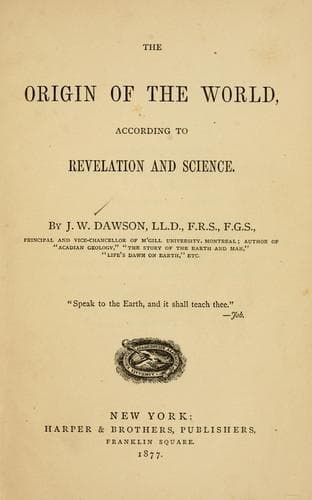
The Origin of the World According to Revelation and ScienceDawson, John William, Sir
Religion
The Origin of the World According to Revelation and Science
Dawson, John William, Sir
Bible and science; Religion and science
The word "heavens" (_shamayim_) has in Hebrew as in English a variety
of significations. Of material heavens there are, in the quaint
language of Poole, "_tres regiones, ubi aves, ubi nubes, ubi sidera_;"
or (1) the atmosphere or firmament;[34] (2) the region of clouds in
the upper part of the atmosphere;[35] (3) the depths of space
comprehending the starry orbs.[36] Besides these we have the "heaven
of heavens," the abode of God and spiritual beings.[37] The
application of the term "heaven" to the atmosphere will be considered
when we reach the 6th and 7th verses. In the mean time we may accept
the word in this place as including the material heavens in the widest
sense: (1.) Because it is not here, as in verse 8th, restricted to the
atmosphere by the terms of the narrative; this restriction in verse
8th in fact implying the wider sense of the word in preceding verses.
(2.) Because the atmospheric firmament, elsewhere called heaven,
divides the waters above from those below, whereas it is evident that
all these waters, and of consequence the materials of the atmosphere
itself, are included in the earth of the following verse. (3.) Because
in verse 14th the sidereal heavens are spoken of as arranged from
pre-existing materials, which refers their actual creation back to
this passage.
In the words now under consideration we therefore regard the heavens
as including the whole material universe beyond the limits of our
earth. That this sense of the word is not unknown to the writers of
Scripture, and that they had enlarged and rational views of the
star-spangled abysses of space, will appear from the terms employed by
Moses in his solemn warning against the Sabaean idolatry, in
Deuteronomy iv.: "And lest thou lift up thine eyes to the heavens, and
when thou seest the sun and the moon and the stars, even all the host
of the heavens, shouldest be incited to worship them and serve them
which Jehovah thy God hath appointed to all nations under the whole
heavens." To the same effect is the expression of the awe and wonder
of the poet king of Israel in Psalm viii.:
"When I consider the heavens, the work of thy fingers,
The moon and the stars which thou hast ordained;
What is man that thou art mindful of him?"
I may observe, however, that throughout the Scriptures the word in
question is much more frequently applied to the atmospheric than to
the sidereal heavens. The reason of this appears in the terms of verse
8th.
Public-domain text, read in full here on John Shaqi.
Reviews
Reviews
No reviews yet
Be the first to share your thoughts on this work.
Elsewhere in the archive
Join the Discussion
Join the discussion
Sign in to leave a comment or review.
Sign InorCreate an account