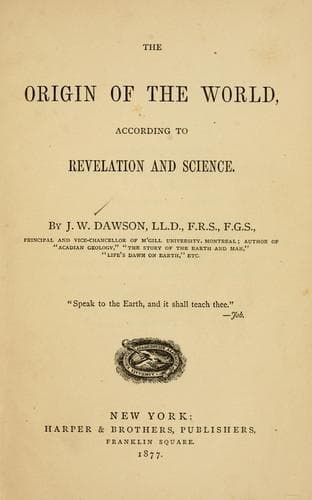
The Origin of the World According to Revelation and ScienceDawson, John William, Sir
Religion
The Origin of the World According to Revelation and Science
Dawson, John William, Sir
Bible and science; Religion and science
If we have correctly referred the term "heavens" to the whole of
extramundane space, then the word "earth" must denote our globe as a
distinct world, with all the liquid and aeriform substances on its
surface. The arrangement of the whole universe under the heads
"heaven" and "earth" has been derided as a division into "infinity and
an atom;" but when we consider the relative importance of the earth to
us, and that it constitutes the principal object of the whole
revelation to which this is introductory, the absurdity disappears,
and we recognize the classification as in the circumstances natural
and rational. The word "earth" (_aretz_) is, however, generally used
to denote the dry land, or even a region or district of country. It is
indeed expressly restricted to the dry land in verse 10th; but as in
the case of the parallel limitation of the word "heaven," we may
consider this as a hint that its previous meaning is more extended.
That it is really so, appears from the following considerations: (1.)
It includes the deep, or the material from which the sea and
atmosphere were afterwards formed. (2.) The subsequent verses show
that at the period in question no dry land existed. If instances of a
similar meaning from other parts of Scripture are required, I give
the following: Genesis ii., 1 to 4, "Thus the heavens and the earth
were finished, and all the host of them;" "these are the generations
of the heavens and the earth." In this general summary of the creative
work, the earth evidently includes the seas and all that is in them,
as well as the dry land; and the whole expression denotes the
universe. The well-known and striking remark of Job, "Who hangeth the
earth upon nothing," is also a case in point, and must refer to the
whole world, since in other parts of the same book the dry land or
continental masses of the earth are said, and with great truth and
propriety, to be supported above the waters on pillars or foundations.
The following passages may also be cited as instances of the
occurrence of the idea of the whole world expressed by the word
"earth:" Exodus x., 29, "And Moses said unto him, As soon as I am gone
out of the city, I will spread abroad my hands unto the Lord, and the
thunder shall cease, neither shall there be any more hail; that thou
mayest know the earth is the Lord's;" Deuteronomy x., 14, "Behold, the
heaven and the heaven of heavens is the Lord's, the earth also, and
all that therein is."
Public-domain text, read in full here on John Shaqi.
Reviews
Reviews
No reviews yet
Be the first to share your thoughts on this work.
Elsewhere in the archive
Join the Discussion
Join the discussion
Sign in to leave a comment or review.
Sign InorCreate an account