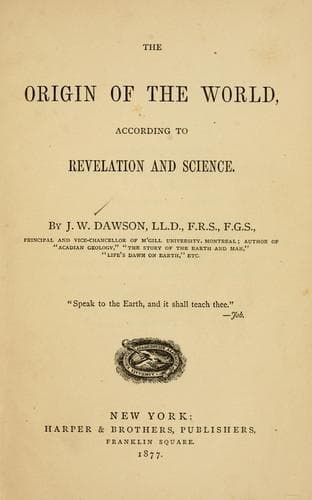
The Origin of the World According to Revelation and ScienceDawson, John William, Sir
Religion
The Origin of the World According to Revelation and Science
Dawson, John William, Sir
Bible and science; Religion and science
How could such a scene be represented in words? since it presented
none of the familiar features of the actual world. Had he attempted to
dilate upon it, he would, in the absence of the facts furnished by
modern science, have been obliged, like the writers of some of the
less simple and primitive cosmogonies already quoted,[42] to adopt the
feeble expedient of enumerating the things not present. He wisely
contents himself with a few well-chosen words, which boldly sketch the
crude materials of a world hopeless and chaotic but for the animating
breath of the Almighty, who has created even that old chaos out of
which is to be worked in the course of the six creative days all the
variety and beauty of a finished world.
In conclusion, the reader will perceive how this reticence of the
author of Genesis strengthens the argument for the primitive age of
the document, and for the vision-theory as to its origin; and will
also observe that, in the conception of this ancient writer, the
"promise and potency" of order and life reside not alone in the atoms
of a vaporous world, but also in the will of its Creator.
CHAPTER VI.
LIGHT AND CREATIVE DAYS.
"And God said, Let light be, and light was; and God saw the
light that it was good, and separated the light from the
darkness; and God called the light Day; and the darkness he
called Night. And Evening was and Morning was--Day
one."--Genesis i., 3-5.
Light is the first element of order and perfection introduced upon our
planet--the first innovation on the old regime of darkness and
desolation. There is a beautiful propriety in this, for the Hebrew
_Aur_ (light) should be viewed as including heat and electricity as
well as light; and these three forces--if they are really distinct,
and not merely various movements of one and the same ether--are in
themselves, or the proximate causes of their manifestation, the prime
movers of the machinery of nature, the vivifying forces without which
the primeval desolation would have been eternal. The statement
presented here is, however, a bold one. Light without luminaries,
which were afterward formed--independent light, so to speak, shining
all around the earth--is an idea not likely to have occurred in the
days of Moses to the framer of a fictitious cosmogony, and yet it
corresponds in a remarkable manner with some of the theories which
have grown out of modern induction.
Public-domain text, read in full here on John Shaqi.
Reviews
Reviews
No reviews yet
Be the first to share your thoughts on this work.
Elsewhere in the archive
Join the Discussion
Join the discussion
Sign in to leave a comment or review.
Sign InorCreate an account