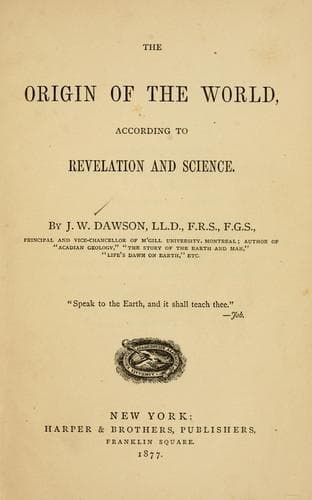
The Origin of the World According to Revelation and ScienceDawson, John William, Sir
Religion
The Origin of the World According to Revelation and Science
Dawson, John William, Sir
Bible and science; Religion and science
I have said that the Hebrew word translated "light" includes the
vibratory movements which we call heat and electricity as well. I make
this statement, not intending to assert that the Hebrews experimented
on these forces in the manner of modern science, and would therefore
be prepared to understand their laws or correlations as fully as we
can. I give the word this general sense simply because throughout the
Bible it is used to denote the solar light and heat, and also the
electric light of the thunder-cloud: "the light of His cloud," "the
bright light which is in the clouds." The absence of "_aur_,"
therefore, in the primeval earth, is the absence of solar radiation,
of the lightning's flash, and of volcanic fires. We shall in the
succeeding verses find additional reasons for excluding all these
phenomena from the darkness of the primeval night.
The light of the first day can not reasonably be supposed to have been
in any other than a visible and active state. Whether light be, as
supposed by the older physicists, luminous matter radiated with
immense velocity, or, as now appears more probable, merely the
undulations of a universally diffused ether, its motion had already
commenced. The idea of the matter of light as distinct from its power
of affecting the senses does not appear in the Scriptures any farther
than that the Hebrew name is probably radically identical with the
word ether now used to express the undulating medium by which light is
propagated; and if it did, the general creation of matter being stated
in verse 1, and the notice of the separation of light and darkness
being distinctly given in the present verse, there is no place left
for such a view here. For this reason, that explanation of these words
which supposes that on the first day the _matter_ of light, or the
ether whose motions produce light, was created, and that on the fourth
day, when luminaries were appointed, it became visible by beginning to
undulate, must be abandoned; and the connection between these two
statements must be sought in some other group of facts than that
connected with the existence of the matter of light as distinct from
its undulations.
What, then, was the nature of the light which on the first day shone
without the presence of any local luminary? It must have proceeded
from luminous matter diffused through the whole space of the solar
system, or surrounding our globe as with a mantle. It was "clothed
with light as with a garment,"
"Sphered in a radiant cloud, for yet the sun was not."
Public-domain text, read in full here on John Shaqi.
Reviews
Reviews
No reviews yet
Be the first to share your thoughts on this work.
Elsewhere in the archive
Join the Discussion
Join the discussion
Sign in to leave a comment or review.
Sign InorCreate an account