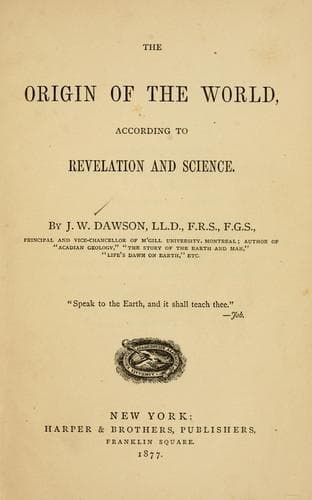
The Origin of the World According to Revelation and ScienceDawson, John William, Sir
Religion
The Origin of the World According to Revelation and Science
Dawson, John William, Sir
Bible and science; Religion and science
We have already rejected the hypothesis that the primeval night
proceeded from a temporary obscuration of the atmosphere; and the
expression, "God said, Let light be," affords an additional reason,
since, in accordance with the strict precision of language which
everywhere prevails in this ancient document, a mere restoration of
light would not be stated in such terms. If we wish to find a natural
explanation of the mode of illumination referred to, we must recur to
one or other of the suppositions mentioned above, that the luminous
matter formed a nebulous atmosphere, slowly concentrating itself
toward the centre of the solar system, or that it formed a special
envelope of our earth, which subsequently disappeared.
We may suppose this light-giving matter to be the same with that which
now surrounds the sun, and constitutes the stratum of luminous
substance which, by its wondrous and unceasing power of emitting
light, gives him all his glory. To explain the division of the light
from the darkness, we need only suppose that the luminous matter, in
the progress of its concentration, was at length all gathered within
the earth's orbit, and then, as one hemisphere only would be
illuminated at a time, the separation of light from darkness, or of
day from night, would be established. This hypothesis, suggested by
the words themselves, affords a simple and natural explanation of a
statement otherwise obscure.
It is an instructive circumstance that the probabilities respecting
the early state of our planet, thus deduced from the Scriptural
narrative, correspond very closely with the most ingenious and truly
philosophical speculation ever hazarded respecting the origin of our
solar system. I refer to the cosmical hypothesis of La Place, which
was certainly formed without any reference to the Bible; and by
persons whose views of the Mosaic narrative are of that shallow
character which is too prevalent, has been suspected as of infidel
tendency. La Place's theory is based on the following properties of
the solar system, which will be found referred to in this connection
in many popular works on astronomy: 1. The orbits of the planets are
nearly circular. 2. They revolve nearly in the plane of the sun's
equator.[43] 3. They all revolve round the sun in one direction, which
is also the direction of the sun's rotation. 4. They rotate on their
axes also, as far as is known, in the same direction. 5. Their
satellites, with the exception of those of Uranus and Neptune, revolve
in the same direction. Now all these coincidences can scarcely have
been fortuitous, and yet they might have been otherwise without
affecting the working of the system; and, farther, if not fortuitous,
they correspond precisely with the results which would flow from the
condensation of a revolving mass of nebulous matter. La Place,
therefore, conceived that in the beginning the matter of our system
existed in the condition of a mass of vaporous material, having a
Public-domain text, read in full here on John Shaqi.
Reviews
Reviews
No reviews yet
Be the first to share your thoughts on this work.
Elsewhere in the archive
Join the Discussion
Join the discussion
Sign in to leave a comment or review.
Sign InorCreate an account