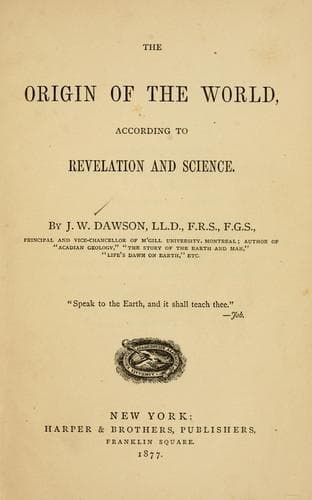
The Origin of the World According to Revelation and ScienceDawson, John William, Sir
Religion
The Origin of the World According to Revelation and Science
Dawson, John William, Sir
Bible and science; Religion and science
To pave the way for a right understanding of the day of creation, it
may be well to consider, in the first place, the manner in which the
_shorter day_ is introduced. In the expression, "God _called_ the
light day," we find for the first time the Creator naming his works,
and we may infer that some important purpose was to be served by this.
The nature of this purpose we ascertain by comparison with other
instances of the same kind occurring in the chapter. God called the
darkness night, the firmament heaven, the dry land earth, the gathered
waters seas. In all these cases the purpose seems to have been one of
verbal definition, perhaps along with an assertion of sovereignty. It
was necessary to distinguish the diurnal darkness from that unvaried
darkness which had been of old, and to discriminate between the
limited waters of an earth having dry land on its surface and those of
the ancient universal ocean. This is effected by introducing two new
terms, night and seas. In like manner it was necessary to mark the new
application of the term earth to the dry land, and that of heaven to
the atmosphere, more especially as these were the senses in which the
words were to be popularly used. The intention, therefore, in all
these cases was to affix to certain things names different from those
which they had previously borne in the narrative, and to certain terms
new senses differing from those in which they had been previously
used. Applying this explanation here, it results that the probable
reason for calling the light day is to point out that the word occurs
in two senses, and that while it was to be the popular and proper term
for the natural day, this sense must be distinguished from its other
meaning as a day of creation. In short, we may take this as a plain
and authoritative declaration _that the day of creation is not the day
of popular speech_. We see in this a striking instance of the general
truth that in the simplicity of the structure of this record we find
not carelessness, but studied and severe precision, and are warned
against the neglect of the smallest peculiarities in its diction.
Public-domain text, read in full here on John Shaqi.
Reviews
Reviews
No reviews yet
Be the first to share your thoughts on this work.
Elsewhere in the archive
Join the Discussion
Join the discussion
Sign in to leave a comment or review.
Sign InorCreate an account