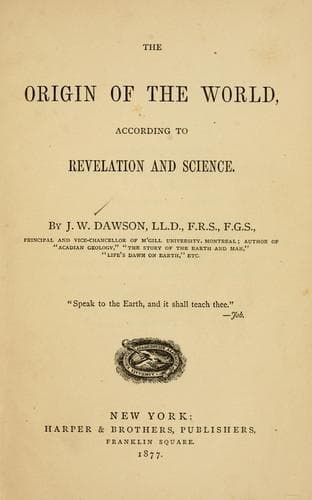
The Origin of the World According to Revelation and ScienceDawson, John William, Sir
Religion
The Origin of the World According to Revelation and Science
Dawson, John William, Sir
Bible and science; Religion and science
What, then, is the day of creation, as distinguished by Moses himself
from the natural day. The general opinion, and that which at first
sight appears most probable, is that it is merely the ordinary civil
day of twenty-four hours. Those who adopt this view insist on the
impropriety of diverting the word from its usual sense. Unfortunately,
however, for this argument, the word is not very frequently used in
the Scriptures for the whole twenty-four hours of the earth's
revolution. Its etymology gives it the sense of the time of glowing or
warmth, and in accordance with this the divine authority here limits
its meaning to the daylight. Accordingly throughout the Hebrew
Scriptures _yom_ is generally the natural and not the civil day; and
where the latter is intended, the compound terms "day and night" and
"evening and morning" are frequently used. Any one who glances over
the word "day" in a good English concordance can satisfy himself of
this fact. But the sense of natural day from sunrise to sunset is
expressly excluded here by the context, as already shown; and all that
we can say in favor of the interpretation that limits the day of
creation to twenty-four hours, is that next to the use of the word for
the natural day, which is its true popular meaning, its use for the
civil day is perhaps the most frequent. It is therefore by no means a
statement of the whole truth to affirm, as many writers have done,
that the civil day is _the ordinary_ meaning of the term. At the same
time we may admit that this is _one_ of its ordinary meanings, and
therefore may be its meaning here. Another argument frequently urged
is that the day of creation is said to have had an evening and
morning. We shall consider this more fully in the sequel, and in the
mean time may observe that it appears rather hazardous to attribute an
ordinary evening and morning to a day which, on the face of the
record, preceded the formation and arrangement of the luminaries which
are "for days and for years."[47]
Public-domain text, read in full here on John Shaqi.
Reviews
Reviews
No reviews yet
Be the first to share your thoughts on this work.
Elsewhere in the archive
Join the Discussion
Join the discussion
Sign in to leave a comment or review.
Sign InorCreate an account