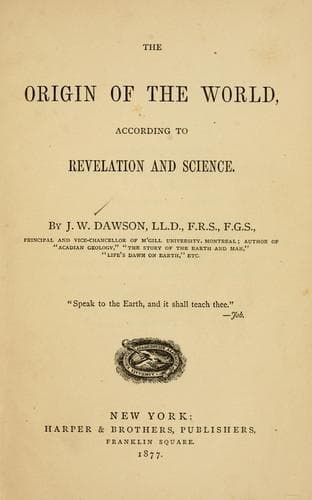
The Origin of the World According to Revelation and ScienceDawson, John William, Sir
Religion
The Origin of the World According to Revelation and Science
Dawson, John William, Sir
Bible and science; Religion and science
That the other writers of the Old Testament understood the creative
days in this sense, might be inferred from the entire absence of any
reference to the work of creation as short, since it occupied only six
days. Such reference we may find in modern writers, but never in the
Scriptures. On the contrary, we receive the impression of the creative
work as long continued. Thus the divine Wisdom says in Prov. viii.,
The Lord possessed me "from the beginning of his way before his works
of old, from everlasting, before the antiquities of the earth." So in
Psalm cxlv., God's kingdom relatively to nature and providence is a
kingdom "of all ages." In Psalm civ., which is a poetical version of
the creative work, and the oldest extant commentary on Genesis i., it
is evident that there was no idea in the mind of the writer of a short
time, but rather of long consecutive processes; and I may remark here
that the course of the narrative itself in Genesis i., implies time
for the replenishing of the earth with various forms of being in
preparation for others, exactly as in Psalm civ.
Perhaps one of the most conclusive arguments in favor of the length of
the creative days is that furnished by the seventh day and the
institution of the Sabbath. In Genesis the seventh day is not said to
have had any evening or morning, nor is God said to have resumed his
work on any eighth day. Consequently the seventh day of creation must
be still current. Now in the fourth commandment the Israelites are
enjoined to "remember the Sabbath-day," because "in six days God
created the heavens and the earth." Observe here that the Sabbath is
to be remembered as an institution already known. Observe farther that
the commandment is placed in the middle of the Decalogue, a solitary
piece of apparently arbitrary ritual amid the plainest and most
obvious moral duties. Observe also that the reason given--namely,
God's six days' work and seventh day's rest--seems at first sight both
far-fetched and trivial, as an argument for abstaining from work in a
seventh part of our time. How is all this to be explained? Simply, I
think, on the supposition that the Lawgiver, and those for whom he
legislated, knew beforehand the history of creation and the fall, as
we have them recorded in Genesis, and knew that God's days are aeons.
The argument is not, "God worked on six natural days, and rested on
the seventh; do you therefore the same." Such an argument could have
no moral or religious force, more especially as it could not be
affirmed that God habitually works and rests in this way. The argument
reaches far deeper and higher. It is this. God created the world in
six of his days, and on the seventh rested, and invited man in Eden to
enter on his rest as a perpetual Sabbath of happiness. But man fell,
and lost God's Sabbath. Therefore a weekly Sabbath was prescribed to
him as a memorial of what he had lost, and a pledge of what God has
Public-domain text, read in full here on John Shaqi.
Reviews
Reviews
No reviews yet
Be the first to share your thoughts on this work.
Elsewhere in the archive
Join the Discussion
Join the discussion
Sign in to leave a comment or review.
Sign InorCreate an account