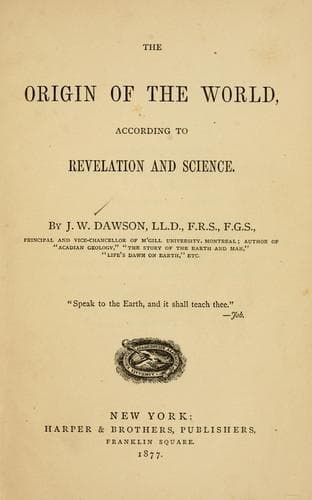
The Origin of the World According to Revelation and ScienceDawson, John William, Sir
Religion
The Origin of the World According to Revelation and Science
Dawson, John William, Sir
Bible and science; Religion and science
This use of the word "day" is, however, not limited to cases of the
occurrence of the formula "in the day." The following are a few out of
many instances that might be quoted: Job xviii., 20, "They that come
after him shall be astonished at his day;" Job xv., 32, "It shall be
accomplished before his _time_;" Judges xviii., 30, "Until the day of
the captivity of the land;" Deut. i., 39, "And your children which in
that day had no knowledge of good and evil;" Gen. xxxix., 10, "And it
came to pass about that time" (on that day). We find also abundance of
such expressions as "day of calamity," "day of distress," "day of
wrath," "day of God's power," "day of prosperity." In such passages
the word is evidently used in the sense of era or period of time, and
this in prose as well as poetry.
There is a remarkable passage in the Psalms, which conveys the idea of
a day of God as distinct from human or terrestrial days:
"Before the mountains were brought forth,
Or ever thou hadst formed the earth and the world,
Even from everlasting to everlasting, thou art God.
Thou turnest man to destruction,
And sayest, Return, ye children of men;
For a thousand years are in thy sight as yesterday when it is past,
And as a watch in the night."[48]
It is a singular coincidence that the authorship of this Psalm is
attributed to Moses, and that its style and language correspond with
the songs credited to him in Deuteronomy. It is farther to be observed
that the reference is to the long periods employed in creation as
contrasted with the limited space of years allotted to man. Its
meaning, too, is somewhat obscured by the inaccurate translation of
the third line. In the original it is, "From _olam_ to _olam_ thou
art, O El"--that is, "from age to age." These long ages of creation,
constituting a duration to us relatively eternal, were so protracted
that even a thousand years are but as a watch in the night. If this
Psalm is rightly attributed to the author of the first chapter of
Genesis, it seems absolutely certain that he understood his own
creative days as being _Olamim_ or aeons. The same thought occurs in
the Second Epistle of Peter: "One day is with the Lord as a thousand
years, and a thousand years as one day."
Public-domain text, read in full here on John Shaqi.
Reviews
Reviews
No reviews yet
Be the first to share your thoughts on this work.
Elsewhere in the archive
Join the Discussion
Join the discussion
Sign in to leave a comment or review.
Sign InorCreate an account