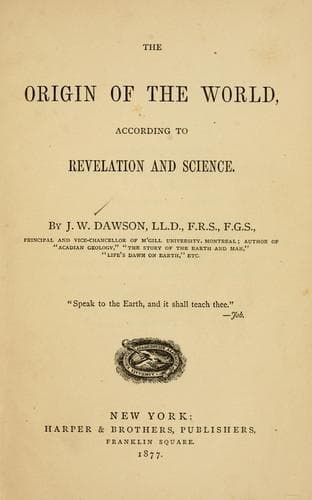
The Origin of the World According to Revelation and ScienceDawson, John William, Sir
Religion
The Origin of the World According to Revelation and Science
Dawson, John William, Sir
Bible and science; Religion and science
(4.) It has been urged that in cases where day is used to denote
period, as in the expressions "day of calamity," etc., the adjuncts
plainly show that it can not mean an ordinary day. In answer to this,
I merely refer to the internal evidence already adduced, and to the
deliberate character of the statements, in the manner rather of the
description of processes than of acts. The difficulties attending the
explanation of the evening and the morning, and the successive
creation of herbivorous and carnivorous animals, are also strong
indications which should serve here to mark the sense, just as the
context does in the cases above referred to.
(5.) In Professor Hitchcock's valuable and popular "Religion of
Geology," I find some additional objections, which deserve notice as
specimens of the learned trifles which pass current among writers on
this subject, much to the detriment of sound Scriptural literature. I
give them in the words of the author. 1. "From Genesis ii., 5 compared
with Genesis i., 11 and 12, it seems that it had not rained on the
earth till the third day; a fact altogether probable if the days were
of twenty-four hours, but absurd if they were long periods." It
strikes us that the absurdity here is all on the side of the short
days. Why should any prominence be given to a fact so common as the
lapse of two ordinary days without rain, more especially if a region
of the earth and not the whole is referred to, and in a document
prepared for a people residing in climates such as those of Egypt and
Palestine. But what could be more instructive and confirmatory of the
truth of the narrative than the fact that in the two long periods
which preceded the formation and clearing up of the atmosphere or
firmament, on which rain depends, and the elevation of the dry land,
which so greatly modifies its distribution, there had been no rain
such as now occurs. This is a most important fact, and one of the
marked coincidences of the record with scientific truth. The
objection, therefore, merely shows that the ordinary day hypothesis
tends to convert one of the finest internal harmonies of this
wonderful history into an empty and, in some respects, absurd
commonplace. 2. "This hypothesis (that days are long periods) assumes
that Moses describes the creation of all the animals and plants that
have ever lived on our globe. But geology decides that the species now
living, since they are not found in the rocks any lower than man
is,[55] could not have been contemporaneous with those in the rocks,
but must have been created when man was--that is, in the sixth day. Of
such a creation no mention is made in Genesis; the inference is that
Moses does not describe the creation of the existing races, but only
of those that lived thousands of years earlier, and whose existence
was scarcely suspected till modern times. Who will admit such an
absurdity?" In answer to this objection, I remark that it is based on
a false assumption.
Public-domain text, read in full here on John Shaqi.
Reviews
Reviews
No reviews yet
Be the first to share your thoughts on this work.
Elsewhere in the archive
Join the Discussion
Join the discussion
Sign in to leave a comment or review.
Sign InorCreate an account