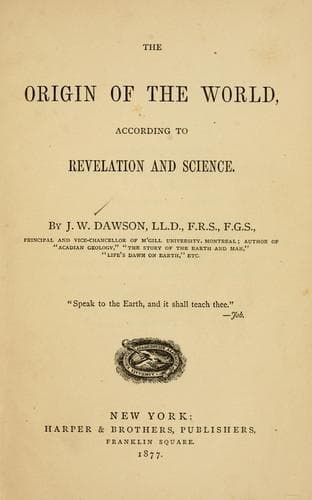
The Origin of the World According to Revelation and ScienceDawson, John William, Sir
Religion
The Origin of the World According to Revelation and Science
Dawson, John William, Sir
Bible and science; Religion and science
The hypothesis of long periods does not require us
to assume that Moses notices all the animals and plants that have ever
lived, but on the contrary that he informs us only of the _first
appearance_ of each great natural type in the animal and vegetable
kingdoms; just as he informs us of the first appearance of dry land on
the third day, but says nothing of the changes which it underwent on
subsequent days. Thus plants were created on the third day, and though
they may have been several times destroyed and renewed as to genera
and species, we infer that they continued to exist in all the
succeeding days, though the inspired historian does not inform us of
the fact. So also many tribes of animals were created in the early
part of the fifth day, and it is quite unnecessary for us to be
informed that these tribes continued to exist through the sixth day.
If the days were long periods, the inspired writer could not have
adopted any other course, unless he had been instructed to write a
treatise on Palaeontology, and to describe the fauna and flora of each
successive period with their characteristic differences. 3. "Though
there is a general resemblance between the order of creation as
described in Genesis and by geology, yet when we look at the details
of the creation of the organic world, as required by this hypothesis,
we find manifest discrepancy. Thus the Bible represents plants only to
have been created on the third day, and animals not till the fifth;
and hence at least the lower half of the fossiliferous rocks ought to
contain nothing but vegetables. Whereas in fact the lower half of
these rocks, all below the carboniferous, although abounding in
animals, contain scarcely any plants, and these in the lowest strata
fucoids or sea-weeds. But the Mosaic account evidently describes
flowering and seed-bearing plants, not flowerless and seedless algae.
Again, reptiles are described in Genesis as created on the fifth day;
but reptilia and batrachians existed as early as the time when the
lower carboniferous and even old red sandstone were in course of
deposition, as their tracks on those rocks in Nova Scotia and
Pennsylvania evince.[56] In short, if we maintain that Moses describes
fossils as well as living species, we find discrepancy instead of
correspondence between his order of creation and that of geology." In
this objection it is assumed that the geological history of the earth
goes back to the third day of creation, or, in other words, to the
dawn of organic life. None of the greater authorities in geology
would, however, now venture to make such an assertion, and the
progress of geology is rapidly making the contrary more and more
probable. The fact is that, on the supposition that the days of
creation are long periods, the whole series of the fossiliferous rocks
belongs to the fifth and sixth days; and that for the early plant
creation of the third day, and the great physical changes of the
Public-domain text, read in full here on John Shaqi.
Reviews
Reviews
No reviews yet
Be the first to share your thoughts on this work.
Elsewhere in the archive
Join the Discussion
Join the discussion
Sign in to leave a comment or review.
Sign InorCreate an account