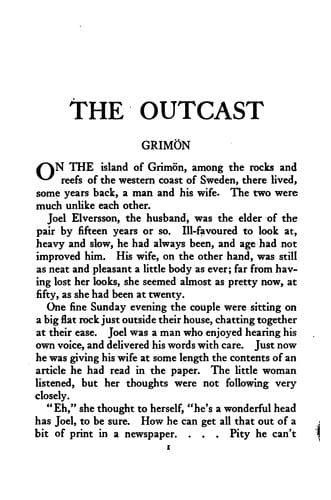
"But I was listening," his wife protested, somewhat discomfited. "I've
got it all in my head now. How they lost their ship the very first
winter and managed to build a snow house, and had to stay and live there
for over a year, till all their food was gone, and they were chewing
bits of hide."
There was a note of vexation in her voice, and her mouth twitched in a
way it often did when anything troubled her.
"Wonder how it would feel," suggested her husband, casually, "if 'twas
one of our own blood had been there starving in a snow hut."
The woman glanced at him sharply. What did he mean by that now?
Something, surely. But Joel sat staring before him, with no trace of
expression in his rheumy eyes.
"Well, if we were to spend all our time sitting thinking of other folks'
troubles, there'd be little pleasure in life," she said, apologetically.
"And, anyhow, they were saved in the end."
"That's true," Joel admitted. "There was a ship went out to find them,
and they're safe back in England now."
"And all the honour and glory, and live happy ever after," concluded his
wife.
To her mind, there was nothing to be so serious about when all had come
well at last. But her husband went on without changing his tone.
"I dreamt last night about our boy Sven," he said. "Dreamt he came and
stood by my bed and said I'd done him a sore wrong. I won't say if I've
any gift of dreaming true as a rule, and I don't know if there's
anything in this or not. But it's a queer thing, all the same, to see
his name in the paper here to-day."
The last words were spoken carelessly, as if the speaker were thinking
only of himself. But from that moment he had no reason to complain of
want of attention in his listener. His wife came close to him and
deluged him with questions: Where was the name? What was it he had
dreamt? Was there really anything about their boy Sven? Her voice grew
shrill, her nose flushed, and tears stood in her eyes.
Had it been any other of their children, she would have been less easily
moved. But it was different with Sven. They had given the boy away, when
nine years old, to an English gentleman and his lady, who had come
sailing along the coast in a yacht. The strangers had simply fallen in
love with the child, and had promised, if he were entrusted to them, to
bring him up as their own, as a rich gentleman, and make him their heir.
It was a wonderful prospect for the lad; his parents had felt that for
his own sake they dared not refuse. If he stayed with them, he would
have none to help him but themselves. And he was a bright child, with a
clever head; they had often agreed that he would surely get on in the
world if he had but the chance in his upbringing.
Seventeen years now since they had let him go, and during all that time
they had heard nothing from him. Never a letter, never a word of
greeting. They knew no more of him than if he had lain at the bottom of
the sea.
Public-domain text, read in full here on John Shaqi.
Reviews
Reviews
No reviews yet
Be the first to share your thoughts on this work.
Join the Discussion
Join the discussion
Sign in to leave a comment or review.
Sign InorCreate an account