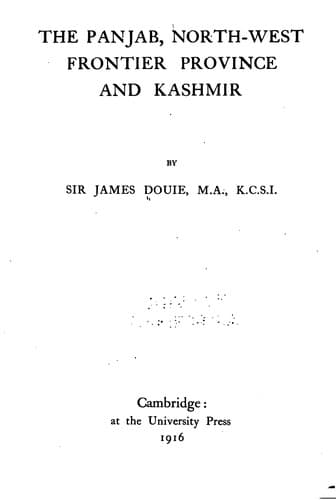
The Panjab, North-West Frontier Province, and KashmirDouie, James McCrone, Sir
History
The Panjab, North-West Frontier Province, and Kashmir
Douie, James McCrone, Sir
India -- Description and travel; Jammu and Kashmir (India); North-west Frontier Province (Pakistan); Punjab (India)
~Bahawalpur~ is by far the largest of the Panjab States. But the greater
part of it is at present desert, and the population, except in the river
tract, is very sparse. Bahawalpur stretches from Ferozepore on the north
to the Sindh border. It has a river frontage exceeding 300 miles on the
Sutlej, Panjnad, and Indus. The cultivated area in 1903-4 was 1451
square miles, and of this 83 p.c. was irrigated and 10 p.c. flooded. The
rainfall is only five inches and the climate is very hot. South and east
of the rivers is a tract of low land known as the "Sindh," which widens
out to the south. It is partly flooded and partly irrigated by
inundation canals with the help of wells. Palm groves are a conspicuous
feature in the Sindh. Behind it is a great stretch of strong loam or
"_pat_," narrow in the south, but widening out in the north. It is
bounded on the south-east by a wide depression known as the Hakra,
probably at one time the bed of the Sutlej. At present little
cultivation is possible in the _pat_, but there is some hope that a
canal taking out on the right bank of the Sutlej in Ferozepore may bring
the water of that river back to it. South of the Hakra is a huge tract
of sand and sand dunes, known as the Rohi or Cholistan, which is part of
the Rajputana desert. There are three _nizamats_, Minchinabad in the
north, Bahawalpur in the middle, and Khanpur in the south. The capital,
Bahawalpur, is close to the bridge at Adamwahan by which the N.W.
Railway crosses the Sutlej. The ruling family belongs to the Abbasi
Daudpotra clan, and came originally from Sindh. Sadik Muhammad Khan, who
received the title of Nawab from Nadir Shah, when he invaded the Derajat
in 1739, may be considered the real founder of the State. The Nawab
Muhummad Bahawal Khan III, threatened with invasion by Maharaja Ranjit
Singh, made a treaty with the British Government in 1833. He was our
faithful ally in the first Afghan War, and gave valuable help against
Diwan Mulraj in 1848. The next three reigns extending from 1852 to 1866
were brief and troubled. Nawab Sadik Muhummad Khan IV, who succeeded in
1866, was a young child, and for the next thirteen years the State was
managed by Captain Minchin and Captain L. H. Grey as Superintendents.
The young Nawab was installed in 1879, and henceforth ruled with the
help of a Council. In the Afghan War of 1879-1880 Bahawalpur did very
useful service. The Nawab died in 1899. A short minority followed during
which Colonel L. H. Grey again became Superintendent. The young Nawab,
Muhammad Bahawal Khan V, had but a brief reign. He was succeeded by the
present Chief, Nawab Sadik Muhummad Khan V, a child of eight or nine
years. The State is managed by a Council aided by the advice of the
political Agent. From 1903 to 1913, the Agent for the Phulkian States
was in charge, but a separate Agent has recently been appointed for
Bahawalpur and Faridkot. An efficient camel corps is maintained for
imperial service.
Public-domain text, read in full here on John Shaqi.
Reviews
Reviews
No reviews yet
Be the first to share your thoughts on this work.
Elsewhere in the archive
Join the Discussion
Join the discussion
Sign in to leave a comment or review.
Sign InorCreate an account