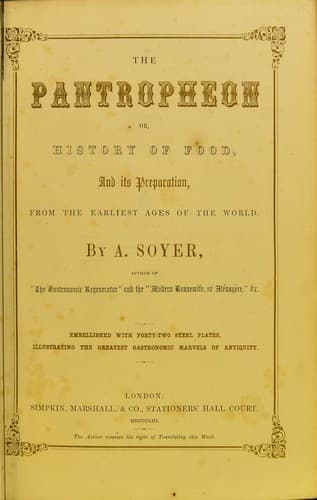
The Pantropheon; Or, History of Food, Its Preparation, from the Earliest Ages of the WorldSoyer, Alexis
History
The Pantropheon; Or, History of Food, Its Preparation, from the Earliest Ages of the World
Soyer, Alexis
Cooking; Food; Gastronomy
But, if animal diet has, from time to time, met with a small number of
detractors, what an immense crowd of apologists and adepts has it not
also found! It would signify nothing to name individuals; let us point
out whole nations. Who is not acquainted with the delicacy and luxury of
the Assyrians and Persians? Who is not aware that the genius of the
Greeks improved the culinary art, and that their cooks were famous in
history? What of the Syracusans, whose dainty and curious ideas passed
as a proverb; and of the Athenians, who were so passionately fond of the
pleasures of the table; or of Naples, Tarentum, and Sybaris, so
celebrated for their good cheer? The Romans surpassed even these
refinements and sumptuous repasts: theirs is the honour of the pontiffs’
feasts, the excesses of Capreæ, the profusions of Vitellius, of Galba,
Nero, and Caligula. They have the honour of the banquet of Geta, which
lasted three days, and ended by exhausting the alphabetic list of all
the dishes that the universe could supply.
May heaven preserve us from imitating such prodigies of intemperance and
gluttonous folly; but let us, at least, be allowed to use with
moderation the good that Providence has granted us, and which it has not
forbidden us to make agreeable and savoury. The inhabitants of the air,
earth, and water, entered within our domains, as well as the fruits of
the fields, on the day when the Creator condescended to say to his
creature:
“Every moving thing that liveth shall be meat for you; even as the green
herb have I given you all things.”[XV-26]
REARING OF CATTLE.
All ancient legislators have bestowed the most serious attention to the
rearing and preservation of cattle. The Mosaic law, in this respect,
enters into details which reveal the most profound wisdom, a delicate
and minute research which cannot be too much admired.
More attentive to propagate useful animals than to flatter the
sensuality of nations, this law forbids their being mutilated;[XV-27] it
requires the Hebrews to treat with generosity the companions of their
labour;[XV-28] that they shall interest themselves in the preservation
of their brother’s, and even of their enemies’ oxen;[XV-29] that
different species of unequal strength shall not be yoked together to the
plough;[XV-30] and, in order that the cattle may not suffer from an
excess of hard and constant labour, Moses assures to them at least one
day of rest in a week.[XV-31]
It is well known with what care the patriarchs surrounded their flocks;
for them they wandered from region to region, and only stopped where
pasture was abundant.[XV-32] In imitation of those fathers of nations,
the princes of the East, and the Grecian chiefs, were at first
shepherds;[XV-33] and were, perhaps, indebted to the innocent
occupations of the fields for the sweet and sacred title of pastors of
man.[XV-34]
Public-domain text, read in full here on John Shaqi.
Reviews
Reviews
No reviews yet
Be the first to share your thoughts on this work.
Elsewhere in the archive
Join the Discussion
Join the discussion
Sign in to leave a comment or review.
Sign InorCreate an account