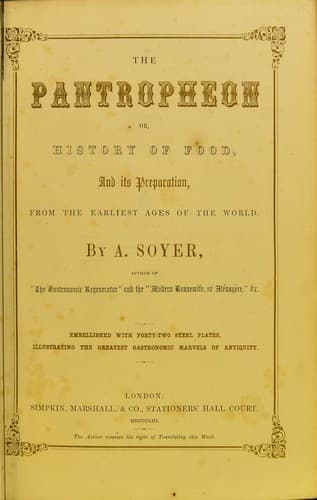
The Pantropheon; Or, History of Food, Its Preparation, from the Earliest Ages of the WorldSoyer, Alexis
History
The Pantropheon; Or, History of Food, Its Preparation, from the Earliest Ages of the World
Soyer, Alexis
Cooking; Food; Gastronomy
At Tyre, in Phœnicia, meat was consumed on the altar, but the gods
had the profit of it, and nobody else. Some fruit and a few vegetables
were sufficient for the frugality of people enjoying innocent and
primitive customs. But it happened, in the time of Pygmalion,[XV-22]
that a young sacrificer having perceived that a piece of the victim had
fallen, hastened to pick it up and replace it carefully on the fire of
the altar. In the performance of this operation he burned his fingers,
and instantly put them into his mouth, to lessen the pain. As he could
not help tasting the fat with which they were covered, the greedy young
man experienced a new sensation, which tempted him to swallow a
mouthful--then a second--a portion of the victim was eaten; he put
another piece under his cloak, and, with his wife, made the finest
supper in his life. All went on very well until the prince, being
informed of this profanation, loaded them with reproaches, and condemned
both to the punishment of death.
Gluttony, however, is rash: other sacrificers ate--at first in
secret--of this forbidden food; then they were imitated; and, at last,
by degrees meat passed from the altar of the gods, who did not taste it,
to the tables of mortals, who feasted upon it.[XV-23] People may or may
not believe this anecdote, which informs us in so satisfactory a manner
of the epoch at which man, from being frugivorous, became carnivorous;
but one thing is certain, that in the time of Homer (there is only
eighty years between him and Pygmalion), the flesh of animals was then
much in fashion, for we read of his giving to his heroes, as their
principal food, a whole hog, three years old, and oxen roasted--not even
jointed.[XV-24]
Some ideologists and dreamers have risen against the use of meat; their
declamations, often very eloquent, have been read; but, from Pythagoras,
a sublime and honest enthusiast, down to the whimsical J. J.
Rousseau--who, by-the-by, was very fond of mutton chops and _bœuf à
la mode_, although he exclaimed against the cruelty of mankind, whose
hands were stained with the blood of animals--no nation has yet
determined to adopt the patriarchal diet of the first ages of the world.
Plutarch was a vegetarian; and we possess one of his treatises, in which
he endeavours to prove that flesh is not the natural food of man.[XV-25]
As a conclusive answer--meat was eaten. So, when an ancient philosopher
one day denied the movement of matter, a person reduced him to silence
by walking.
Public-domain text, read in full here on John Shaqi.
Reviews
Reviews
No reviews yet
Be the first to share your thoughts on this work.
Elsewhere in the archive
Join the Discussion
Join the discussion
Sign in to leave a comment or review.
Sign InorCreate an account