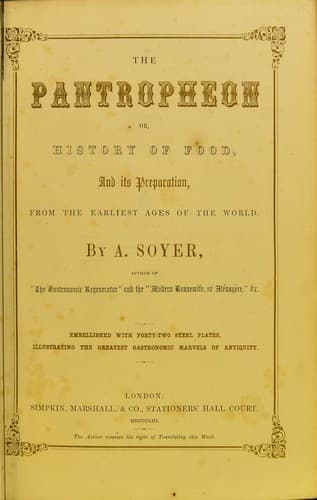
The Pantropheon; Or, History of Food, Its Preparation, from the Earliest Ages of the WorldSoyer, Alexis
History
The Pantropheon; Or, History of Food, Its Preparation, from the Earliest Ages of the World
Soyer, Alexis
Cooking; Food; Gastronomy
The Fannian law unfortunately came, and, as we have before observed,
brought impediments to these beautiful results by interdicting aviaries
and skilfully prepared pastes. It is true that this law allowed a
farm-yard hen to be served at every repast[XVII-25]--_mais une poule par
jour est-ce contentement?_ It became necessary, then, to have recourse
to a _mezzo-termine_, which was discovered in the capon. But the
favourite dish forbidden by the consular authority was not altogether
abandoned: some faithful epicureans always possessed in the shade
well-furnished aviaries; and it was even then, we are assured, that Rome
and the universe were enriched with the _poularde_.[XVII-26]
_Poularde à la Viminale._--Cook a fine hen in its gravy; pound and mix
benzoin, pepper, oil, and garum, a little thyme, fennel seed, cummin,
mint, and rue; stir for a long time; add some vinegar; pound some dates,
and mix them with honey and a little vinegar. Of all this make a
homogeneous seasoning, and pour it on the hen when it is cold.[XVII-27]
THE CHICKEN.
It is certainly surprising that a people so serious as the Romans
generally were, should make the success of the greatest enterprise
depend on the appetite of their famous sacred chickens. They were
brought from the Island of Negropont, and were kept shut up in cages;
their guardian was designated by the name of Pullarius.[XVII-28]
Publius Claudius, constrained to consult these strange prophets before
engaging in a naval combat, ordered them to be fed; they refused to open
their beaks. The incredulous general ordered them at once to be thrown
into the sea, and laughingly exclaimed to the dismayed Pullarius: “Since
they will not eat--well! then let us make them drink.”[XVII-29]
Diodorus of Sicily, and some ancient writers, tell us that the
Egyptians, from a remote period, hatched chickens in ovens. This process
is decidedly of the highest antiquity, and was applied to the eggs of
all kinds of poultry.[XVII-30] In the last century, Réaumur tried
various experiments, and recovered this art, which was thought to have
been lost; others again have followed the steps of this skilful
observer, and, at the present day, obtain the most satisfactory results.
Chickens have ever been considered an estimable food, and hardly yielded
to the two glories of their family--the fattened hen and the
capon.[XVII-31] The Greeks served them at all their feasts of ceremony,
and the Romans granted them a distinguished place among the dishes of
the second course.
Public-domain text, read in full here on John Shaqi.
Reviews
Reviews
No reviews yet
Be the first to share your thoughts on this work.
Elsewhere in the archive
Join the Discussion
Join the discussion
Sign in to leave a comment or review.
Sign InorCreate an account