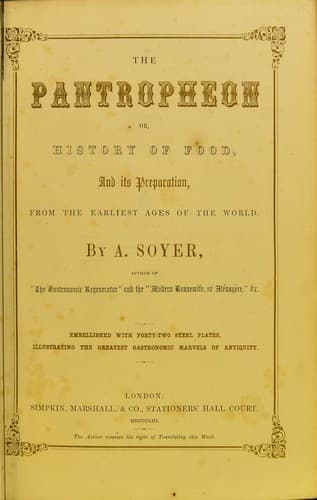
The Pantropheon; Or, History of Food, Its Preparation, from the Earliest Ages of the WorldSoyer, Alexis
History
The Pantropheon; Or, History of Food, Its Preparation, from the Earliest Ages of the World
Soyer, Alexis
Cooking; Food; Gastronomy
_Capon à la Déliaque._--Draw completely a fat capon; then bruise pepper,
alisander, and ginger, which you must mix with sausage-meat and fine
flour, and a pig’s brains cooked; add some eggs, then some garum, a
little oil, whole pepper, and several pine nuts. Make a stuffing of this
mixture, and put it into the capon, which afterwards roast before a slow
fire.[XVII-17]
THE HEN.
The cackling of hens infallibly announced, among the ancients, some
dreadful calamity to the person who had the misfortune to hear
it.[XVII-18] This fatal omen must have rendered a great number of people
unfortunate; for whether she lays eggs, or conducts her young family, a
hen generally cackles.
They therefore sought to diminish the number of these birds of ill-omen;
they fattened them for eating, and they did right, since, according to
learned physicians, the flesh of these birds is good for weakly persons,
as well as those who are convalescent.[XVII-19] Healthy individuals also
find this food suit them perfectly. In Greece there would have been
something wanting at a feast, if fat hens had not been served. They
embellished the celebrated wedding repast of Caranus; and Athenæus often
speaks of them when describing a grand banquet.[XVII-20]
At Rome, the art of fattening them became a serious occupation, which
was long studied, and had its precepts and rules. Marcus Lœlius
Strabo, belonging to the order of knights, invented aviaries in which
hens were confined;[XVII-21] others sought and discovered the means of
giving to their flesh that particular flavour unperceived by
uncultivated palates, but which the experienced gastrophilist always
appreciates. They patiently gave themselves up to laborious experiments:
a warm, narrow, dark spot received these interesting _volatiles_; the
feathers of their wings and tails were plucked, and they were gorged
twice a day during three weeks with balls of barley flour mixed with
soft water. Great cleanliness was combined with this diet: their heads
were well cleansed, and care taken that no insect should enter the
aviary.[XVII-22]
Afterwards barley flour, kneaded with milk, was preferred; then, instead
of milk, water, and honey were employed. Excellent wheaten bread, soaked
in good wine and hydromel, was also used with success.[XVII-23]
Skilful breeders by these means obtained magnificent hens of an
incredibly exquisite flavour, and which weighed no less than sixteen
pounds.[XVII-24]
Public-domain text, read in full here on John Shaqi.
Reviews
Reviews
No reviews yet
Be the first to share your thoughts on this work.
Elsewhere in the archive
Join the Discussion
Join the discussion
Sign in to leave a comment or review.
Sign InorCreate an account