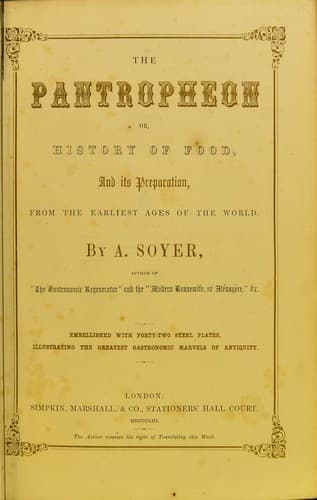
The Pantropheon; Or, History of Food, Its Preparation, from the Earliest Ages of the WorldSoyer, Alexis
History
The Pantropheon; Or, History of Food, Its Preparation, from the Earliest Ages of the World
Soyer, Alexis
Cooking; Food; Gastronomy
There were ducks at that prodigious dinner of the opulent Caranus, of
whom we have already spoken several times. They were always served at
the tables of the rich Greeks;[XVII-39] and Archigenes reckons them
among the viands which agree best with the stomach.[XVII-40] Cato was of
the same opinion; and, if we are to believe Plutarch, he made them the
food of those of his family who were ill, and boasted of maintaining his
children, servants, and himself in perfect health, by the aid of this
diet alone.[XVII-41] It was the same idea that made Mithridates mix the
flesh of ducks with all he ate, as an antidote against poison, which he
feared.[XVII-42]
Hippocrates evinces a contrary opinion. The flesh of this bird seemed to
him hard, heavy, and indigestible.[XVII-43] Avicenna goes still further:
he threatens all who eat it with fever.[XVII-44] The Romans were no more
frightened than the Greeks at the decision of the father of medicine.
Lentulus, one of the high magiric authorities of Rome, ordered that the
duck should figure in the most honourable manner at the brilliant feast
of which Macrobius has preserved us an account.[XVII-45] It must,
however, be remembered that polite people, who observed the forms and
usages of society, only offered to their guests the breast and head of
this biped; the remainder returned to the kitchen.[XVII-46]
_Ducks’ Brains à l’Epicurienne._--Cook some ducks’ brains, and mince
them very small; then place in a saucepan, with pepper, cummin, benzoin
root, garum, sweet wine, and oil; add milk and eggs, and submit the
whole to the action of a slow fire, or rather, cook them in a
_bain-marie_.[XVII-47]
_Apicius’s Seasoning for a Roast Duck._--Make a mixture of pepper,
cummin, alisander, mint, stoned raisins, or Damascus plums; add a little
honey and myrtle wine; place it in a saucepan; cook, and then add to
these substances vinegar, garum, and oil; afterwards some parsley and
savory; serve with the roast duck.[XVII-48]
THE GOOSE.
When a flock of geese are obliged to pass Mount Taurus--the dreaded
abode of their enemies, the eagles--each of them takes the precaution to
hold a stone in its beak, in order that he may keep a profound silence,
which, otherwise, his natural loquacity would render
impossible.[XVII-49] This, if true, would justify Aristotle in
attributing foresight to the goose;[XVII-50] a quality which Scaliger
also claims for this bird.[XVII-51]
The ancients highly esteemed its flesh. Homer[XVII-52] and
Athenæus[XVII-53] speak with praise of the fat geese and goslings which
the Greeks ate.
The Egyptians served them at their meals every day; it was, with veal,
the favourite dish of their monarchs,[XVII-54] and they did not forget
to offer some to King Agesilaus, when he was travelling through the
country.[XVII-55]
Public-domain text, read in full here on John Shaqi.
Reviews
Reviews
No reviews yet
Be the first to share your thoughts on this work.
Elsewhere in the archive
Join the Discussion
Join the discussion
Sign in to leave a comment or review.
Sign InorCreate an account