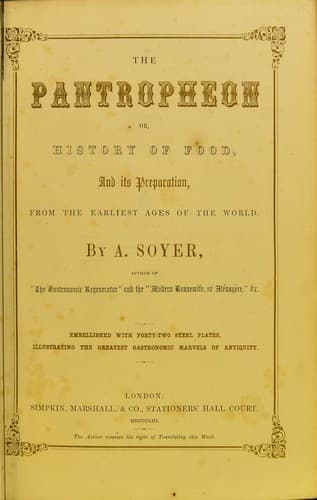
The Pantropheon; Or, History of Food, Its Preparation, from the Earliest Ages of the WorldSoyer, Alexis
History
The Pantropheon; Or, History of Food, Its Preparation, from the Earliest Ages of the World
Soyer, Alexis
Cooking; Food; Gastronomy
It is also said that we owe the importation of it to the Jesuits.
According to Hurtaut, it was not until about the time of Charles IX.
that turkeys appeared in France.[XVII-114] It is asserted, adds this
author, that at the wedding-dinner of that Prince the first turkey was
served, and that it was admired as a very extraordinary thing. The
English tasted this new dish in 1525, the fifteenth year of the reign of
Henry VIII.
To fatten turkeys--every morning, for a month, give them mashed
potatoes, mixed with buck-wheat flour, Indian corn, barley, or beans; a
paste is made of it which they are left to eat as they please. Every
evening what remains must be taken away. One month after, you add to
this food, when they go to roost, half a dozen balls composed of barley
floor, which they are made to swallow for eight days successively; at
the end of that time turkeys, thus fed, become excessively fat,
delicious, and weigh from twenty to twenty-five pounds.
In Provence, walnuts are given to them whole, which they are compelled
to swallow by slipping them one by one with the hand along the neck
until they have all past the œsophagus; they begin with one walnut,
and increase by degrees to forty. This kind of food gives an oily taste
to the flesh.
Turkey eggs are good boiled, and are preferred to those of hens for
pastry; mixing them with the common eggs makes an omelette more
delicate.
“To obtain all the advantages possible from turkeys, they must be killed
at the same time as pigs; then cut the turkeys in quarters, and put them
in earthen pots covered over with the fat of the pork, and by this means
they may be eaten all the year round.”--PARMENTIER.
THE PEACOCK.
The peacock comes originally from India: it was there that Alexander the
Great saw it for the first time. He was so struck with its magnificent
plumage that he forbad all persons, under pain of death, to kill
any.[XVII-115]
Oriental princes kept the peacocks which travellers brought them, from
time to time, in their aviaries.[XVII-116] It was thus[XVII-117] that a
certain king of Egypt received one, of which he thought Jupiter alone
worthy; wherefore he sent it in great pomp to the temple of that
god.[XVII-118]
These birds were thus known over various parts of the world. Samos,
which seems to have been provided one of the first, ornamented its money
with their image.[XVII-119] Their reputation soon spread far and
wide;[XVII-120] and Athenian speculators sent to that island for
peacocks, which were shown to the curious once a month.[XVII-121]
This variety became afterwards an article of commerce, and all wealthy
people became desirous to have them. A male and female cost £8
sterling.[XVII-122] But what was that, when delighted eyes could
contemplate the charming and lovely colours of the haughty favourite of
Juno!
At Rome, the peacock had a prodigious success.[XVII-123] When alive,
the Romans praised its beauty; when dead, it appeared on the tables of
its enthusiastic admirers.
Public-domain text, read in full here on John Shaqi.
Reviews
Reviews
No reviews yet
Be the first to share your thoughts on this work.
Elsewhere in the archive
Join the Discussion
Join the discussion
Sign in to leave a comment or review.
Sign InorCreate an account