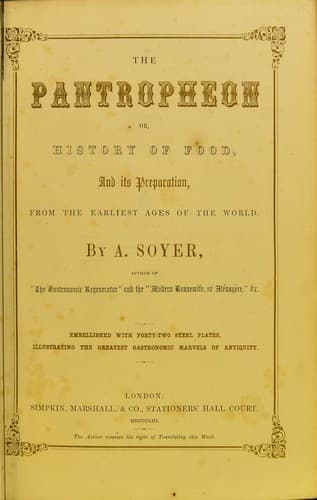
The Pantropheon; Or, History of Food, Its Preparation, from the Earliest Ages of the WorldSoyer, Alexis
History
The Pantropheon; Or, History of Food, Its Preparation, from the Earliest Ages of the World
Soyer, Alexis
Cooking; Food; Gastronomy
Egypt also possessed some of these birds; but there they were still more
rare than in Greece, and formed one of the principal ornaments in the
triumphal pomp of Ptolemy Philadelphus, when he entered Alexandria.
Large cages, containing meleagrides, were carried before the monarch,
and on that day the people knew not which to admire most--the prince or
the turkey.[XVII-106]
They were introduced into Rome about the year 115 before our era; but,
for a long time, they were objects of uncommon curiosity: and Varro, the
first of the Latins who speaks of them, confounds these birds with the
guinea hens, or hens of Numidia.[XVII-107]
A century later, turkeys greatly multiplied, and vast numbers were
reared in the Roman farms. Caligula, who had the good sense to make his
own apotheosis during his life-time, through fear lest it might be
refused after his death, ordered a sacrifice of peacocks, guinea hens,
and turkeys to be made daily before his statue.[XVII-108]
It appears, however, that the breed of turkeys soon began to diminish in
Europe; very few were reared, and that only as a curiosity: in the
citadel of Athens, towards the year 540 of the Christian era;[XVII-109]
and in 1510, two were exhibited in Rome, which belonged to the Cardinal
of Saint Clement.[XVII-110] Jacques Cœur brought some meleagrides
from India, in 1450; they were the first ever seen in France, and it was
not till fifty-four years afterwards that Americus Vespucius made them
known to the Portuguese. In our days these ancient inhabitants of Asia
or America[XVII-111] have become naturalized among us, and let us hope
that the day is yet distant when they will be absentees from our
farm-yards and our tables. We admire them less perhaps than Charles IX.
did when a turkey was served to him for the first time,[XVII-112] but we
shall always receive with cheerfulness the majestic dish upon which
appears a well-fed turkey, truffled, and smoking hot.
_Turkey à l’Africaine._--Roast a turkey; bruise some pepper, alisander,
and benzoin; mix it with wine and garum. Pour this seasoning on the
turkey, sprinkle with pepper, and serve.[XVII-113]
The historian of Provence, Bouche, will have it that the French are
indebted for the turkey to King René, who died in 1480. Other writers
assure us that this volatile was introduced during the reign of Francis
I. by Admiral Chabert. La-Bruyère-Champier speaks of it as a recent
acquisition, and Beckmann refutes those who date its existence in France
previous to the 16th century. He says that this bird, which was wild in
the forests of America, became domesticated in Europe.
Public-domain text, read in full here on John Shaqi.
Reviews
Reviews
No reviews yet
Be the first to share your thoughts on this work.
Elsewhere in the archive
Join the Discussion
Join the discussion
Sign in to leave a comment or review.
Sign InorCreate an account