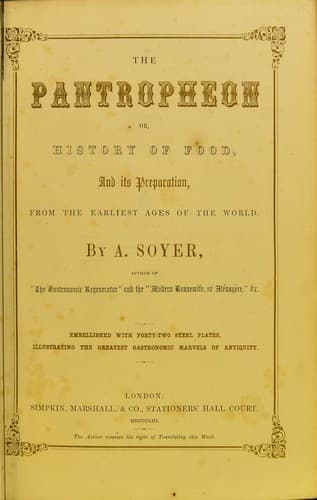
The Pantropheon; Or, History of Food, Its Preparation, from the Earliest Ages of the WorldSoyer, Alexis
History
The Pantropheon; Or, History of Food, Its Preparation, from the Earliest Ages of the World
Soyer, Alexis
Cooking; Food; Gastronomy
Among the Jews, milk was always considered as an emblem of the wealth of
a country and the fertility of its soil; so much so, that the sacred
books almost invariably speak of a happy region, as one “flowing with
milk and honey.”[XVIII-2] This metaphorical expression testifies
sufficiently to the taste of the Hebrews for this aliment, which their
King Solomon recommended to them in these terms: “and thou shalt have
goat’s milk enough for thy food, for the food of thy household, and for
the maintenance of thy maidens.”[XVIII-3]
Profane antiquity agrees on this point with our holy chroniclers. It
represents to us the first men, free from passions and fears, surrounded
by streams of milk and nectar, from which they drew health and
life.[XVIII-4] Happy time! ere milk-maids existed to practise those
deceptions they have now imbibed from the deceitful arts of chemistry.
The greater part of the wandering tribes, such as the Getes and
Scythians, were galactophagists,[XVIII-5] or drinkers of milk;[XVIII-6]
the Gauls[XVIII-7] and Germans[XVIII-8] made it also their principal
food. In Greece and Italy, the shepherds decorated the vessels in which
they had just milked their flocks with crowns of flowers; and, in honour
of the rural divinities, they scattered about a small quantity of this
sweet liquid.[XVIII-9] The reapers offered it to Ceres;[XVIII-10] and in
one of the sections of Rome, Mercury was presented with milk instead of
wine.
The ancients attributed to milk from cows, ewes, and goats, various
Hygeian qualities.[XVIII-11] Hippocrates forbade it in cases of
head-ache, fevers, and bilious attacks;[XVIII-12] but he sometimes
ordered asses’ milk,[XVIII-13] which was considered as an excellent
remedy, and a most wholesome aliment.[XVIII-14]
The voluptuous people of Rome rubbed their faces and skins with bread
soaked in asses’ milk, to make them fairer and prevent the beard from
growing too fast.
Suetonius[XVIII-15] and Martial[XVIII-16] speak of these refinements of
luxurious delicacies. The satirical Juvenal informs us that bread was
made into a kind of plaster or mask, with which they covered the
face.[XVIII-17] Poppæia, wife of Nero, was the first, or one of the
first, to bring this recipe into fashion, being fully persuaded that she
would thus preserve the whiteness and delicacy of her skin. Five hundred
asses used to supply daily the necessary quantity of milk to make the
cosmetic and bath[XVIII-18] of the coquettish empress.
This high patronage did not prevent asses’ milk from losing by
degrees--and very unjustly, no doubt--the reputation it
acquired.[XVIII-19]
Fashion--capricious and all-powerful deity--undertook to re-instate its
virtues, after several centuries of profound forgetfulness. The success
was complete. This is how the affair took place:--
Public-domain text, read in full here on John Shaqi.
Reviews
Reviews
No reviews yet
Be the first to share your thoughts on this work.
Elsewhere in the archive
Join the Discussion
Join the discussion
Sign in to leave a comment or review.
Sign InorCreate an account