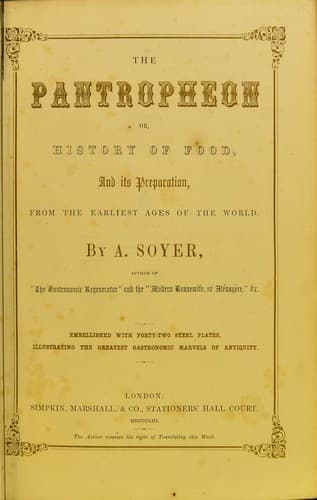
The Pantropheon; Or, History of Food, Its Preparation, from the Earliest Ages of the WorldSoyer, Alexis
History
The Pantropheon; Or, History of Food, Its Preparation, from the Earliest Ages of the World
Soyer, Alexis
Cooking; Food; Gastronomy
Francis I., finding himself weak and languishing, the physicians, after
a long consultation on the monarch’s illness, advised remedies which did
not cure the royal patient. However, the King of France was getting
worse every day, and his state gave serious apprehensions. Some one
mentioning to his Majesty that a Jew of Constantinople was noted as one
of the cleverest doctors in the world, Francis immediately ordered his
ambassador in Turkey to send him this Israelitish doctor, whatever might
be the cost. The Jew arrived, and prescribed no other remedy than asses’
milk. The king found himself much better, and the courtiers and ladies
of the court eagerly followed the same diet, even for the slightest
imaginary indisposition.
A patient, cured by the use of this wholesome and restorative food,
thought of expressing his gratitude by the following stanza:--
“Par sa bonté, par sa substance
D’une ânesse le lait m’a rendu la santé;
Et je dois plus en cette circonstance,
Aux ânes qu’à la faculté.”
_Macédoine Germanique of Milk._--Pound dry almonds, and put them into a
stewpan with the following ingredients:--the most delicate parts of
mallows only, and white-beet, some leeks, parsley, and other leguminous
herbs, previously cooked, a fowl boiled and minced small, the brains of
poultry or sucking pigs, also boiled, and lastly, some hard eggs cut in
two. Put all these together, as mentioned before; some little time after
that, add sausage meat, fowls’ livers, fresh cod fish, and oysters--the
whole reduced into pulp--some fresh cheese, pine nuts, and whole pepper.
Whilst this is boiling on a very slow fire, prepare the following
seasoning: pound some pepper, alisander, parsley seeds, and silphium;
stew separately with gravy; mix raw eggs with a great quantity of milk;
add it to the preceding seasoning; pour it over the contents of the
stewpan, then pepper, and serve.[XVIII-20]
BUTTER.
A learned writer[XVIII-21] has maintained that the ancient inhabitants
of the east did not know of butter, and that by this word must be
understood, when it occurs in the holy writings, _sour milk_ or _cream_.
Whatever may be the respect due to the grave authority of Beckmann, we
beg leave to adhere to the opinion of various translators of the Bible,
and believe with them that the Jews knew how to prepare butter.
Independently of the signification of _chemack_, to which a profound
philosopher gives the same sense,[XVIII-22] and which appears very
naturally to offer this acceptation, we could still fortify our opinion
by the passage where Job, recalling with sorrow the happy days of his
youth, says, that he used to wash his “feet in butter.”[XVIII-23] We
agree that these words are understood in a figurative sense, and that
the man of God wished to show by it that he was the possessor of a great
number of flocks.
Public-domain text, read in full here on John Shaqi.
Reviews
Reviews
No reviews yet
Be the first to share your thoughts on this work.
Elsewhere in the archive
Join the Discussion
Join the discussion
Sign in to leave a comment or review.
Sign InorCreate an account