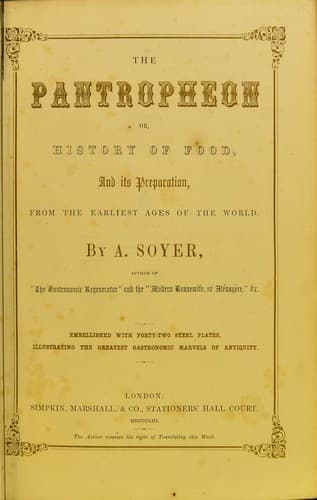
The Pantropheon; Or, History of Food, Its Preparation, from the Earliest Ages of the WorldSoyer, Alexis
History
The Pantropheon; Or, History of Food, Its Preparation, from the Earliest Ages of the World
Soyer, Alexis
Cooking; Food; Gastronomy
Formerly it was required in many countries that the dealer in this
article should sell good butter to his customers. In France, for
instance, intolerance was carried so far as to forbid “all persons to
re-scrape, beat, or work up any butter, either fresh or salted; change,
mix, or mingle it, under _pain of being whipped_.”[XVIII-35] Since then
the strangeness of such a measure has become palpable, the more so as
modern good faith and honesty render it more useless than ever.
During the early ages of the Church, butter was burned in the lamps
instead of oil. This practice is still continued in Abyssinia.[XVIII-36]
The cathedral of Rouen has a tower, called the “Butter Tower.” It
acquired this name from the fact that George d’Amboise, who was
archbishop of that city in 1500, seeing that oil was scarce in his
diocese during Lent, authorised the use of butter, on condition that
each diocesan should pay _six deniers Tournois_ (about a farthing) for
the permission. The money obtained by these means served to construct
the “Butter Tower.”[XVIII-37]
To obtain butter instantly it is only necessary, in summer, to put new
milk into bottles some hours after it has been taken from the cow, and
shake it briskly. The clots which form, thrown into a sieve, washed and
pressed together, constitute the finest and most delicate butter that
can possibly be made.
One of the great means of preserving butter fresh for any length of time
is, first to press all the buttermilk completely out, then to keep it
under water (renewing the water frequently), and to abstract it from the
influence of heat and air by wrapping it in a wet cloth.
When butter has become very rancid, it is melted several times by a
moderate heat, with or without the addition of water, and, as soon as it
has been malaxated, after the cooling, in order to extract any water it
may have retained, it is put into brown freestone pots, sheltered from
the contact of the air. Frequently, when it is melted, a piece of
toasted bread is put into it, which acts in the same manner as charcoal;
that is to say, it attenuates the rancidity.[XVIII-38]
CHEESE.
A demi-god, Aristæus, the son of Apollo, and King of Arcadia, invented
cheese,[XVIII-39] and the whole of Greece welcomed with gratitude this
royal and almost divine present. Sober individuals willingly ate some at
their meals;[XVIII-40] gluttons perceived that it sharpened the
appetite; and great drinkers that it provoked copious libations. Thus
the aged Nestor, wise as he was, brought wine to Machaon, who had just
been wounded in the right arm, and did not fail to add to it goat cheese
and an onion, to force him to drink more.[XVIII-41]
This food was also well known to the Hebrews, and the holy writings
sometimes mention it.[XVIII-42]
Public-domain text, read in full here on John Shaqi.
Reviews
Reviews
No reviews yet
Be the first to share your thoughts on this work.
Elsewhere in the archive
Join the Discussion
Join the discussion
Sign in to leave a comment or review.
Sign InorCreate an account