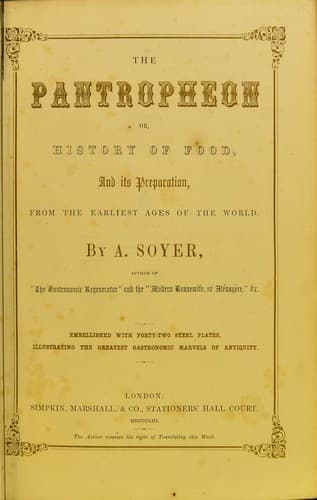
The Pantropheon; Or, History of Food, Its Preparation, from the Earliest Ages of the WorldSoyer, Alexis
History
The Pantropheon; Or, History of Food, Its Preparation, from the Earliest Ages of the World
Soyer, Alexis
Cooking; Food; Gastronomy
But it is nevertheless true, that this metaphorical locution recalls
also one of the uses made of that fat substance, which was for a long
while employed, like oil, to soften and refresh the limbs.
Indulgent reader, excuse this episode upon a ground which we ought not
to touch, and let us re-enter the kitchen.
The Greeks, who understood many things, and knew them so well, passed
over several centuries without once thinking that the milk of their ewes
and cows contained a food already well-known by several barbarous
nations. Aristotle mentions the serous part of milk, and
cheese;[XVIII-24] but he hardly suspects the existence of butter, which
he describes but very imperfectly as a liquid oil.[XVIII-25] Antecedent
to him, Hippocrates never thought of it, except as a foreign remedy
which Asia supplied to Greece.[XVIII-26]
It was only fifty years after Aristotle that it began to be noticed as
an aliment. The Greeks, in imitation of the Parthians and Scythians, who
used to send it to them, had it served upon their tables, and called it
at first “oil of milk,”[XVIII-27] and later, _bouturos_, “cow cheese,”
probably on account of the quantity made from the milk of that
animal.[XVIII-28]
The Germans, according to Beckmann, taught the Romans how to make
butter, but they never employed it otherwise than as a remedy in Italy.
It is certain that in the time of Pliny it had hardly been heard of at
Rome,[XVIII-29] and that, according to this writer, the barbarians
only--that is to say, those who were unfortunate enough not to be either
Greeks or Romans--made their food of it.[XVIII-30] Towards the year 175
of the Christian era, Galen then placed butter only among the
therapeutic agents useful in medicine.[XVIII-31] However, more than a
century before him, Dioscorides wished it to be noticed that fresh
butter made of ewes’ or goats’ milk was served at meals instead of oil,
and that it took the place of fat in making pastry.[XVIII-32]
Herodotus has preserved some interesting details on the manipulation of
butter among the Scythians. They received the milk in large pails, and
beat it for a long time to separate the most delicate part, and
appointed for this labour those enemies whom the fortune of war
delivered into their hands. These unhappy creatures were deprived of
sight, which prevented their escape.[XVIII-33]
The Romans set about making butter as we do. Pliny says: “Butter is made
from milk, and this aliment, so much sought after by barbarous nations,
distinguished the rich from the common people. It is obtained
principally from cows’ milk; that from ewes is the fattest. Goats also
supply some. It is produced by agitating the milk in long vessels with a
narrow opening. A little water is added.”[XVIII-34]
Public-domain text, read in full here on John Shaqi.
Reviews
Reviews
No reviews yet
Be the first to share your thoughts on this work.
Elsewhere in the archive
Join the Discussion
Join the discussion
Sign in to leave a comment or review.
Sign InorCreate an account