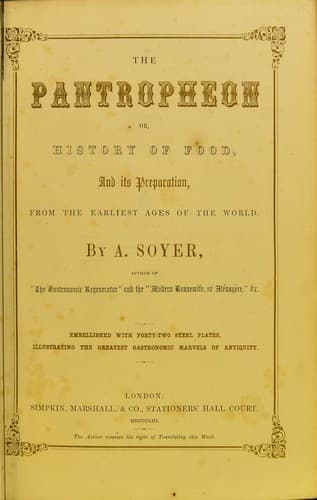
The Pantropheon; Or, History of Food, Its Preparation, from the Earliest Ages of the WorldSoyer, Alexis
History
The Pantropheon; Or, History of Food, Its Preparation, from the Earliest Ages of the World
Soyer, Alexis
Cooking; Food; Gastronomy
The art of giving a relish to the cheese, by mixing with it odoriferous
herbs, is said to be more than nine hundred years old. This operation
was designated _persiller_, showing that originally parsley was
introduced.[XVIII-57] We cannot say whether the Romans made use of this
plant to give a pungency to their cheese, but it is certain that they
often mixed some herbs with it.[XVIII-58] Thus Columella informs us that
sometimes the leaves and small branches of the fig tree were used to
communicate an agreeable flavour.[XVIII-59] The same writer has
transmitted to us a very simple process, much in use in his time, for
preserving cheese. They first covered it with brine, and then dried it
in a thick smoke obtained from straw or green wood.[XVIII-60]
The following are some of the dishes of which cheese served as the
basis:--
_Salad of Cheese à la Bithynienne._--Cut some slices of excellent bread;
leave them for some time in vinegar and water; then make a mixture of
this bread with pepper, mint, garlic, and green coriander; throw on it a
good quantity of cow’s cheese salted; add water, oil, and
wine.[XVIII-61]
_Dish of Tromelian Cheese._--Take fresh cheese; mix it well with pepper,
alisander, dried mint, pine nuts, sun raisins, and dates; then add
honey, vinegar, and afterwards, garum, oil, wine, and cooked
wine.[XVIII-62]
The celebrated cheese of Rouergue, known under the name of “Roquefort
cheese,” was made, in the 17th century as follows--we cite from
Marcorelle:--
“The curd employed is made from sheep’s milk, mixed with a little goat’s
milk. It is broken as small as possible. When it is taken from the
moulds, it is bound with a linen band and taken to the drying room; then
to the caves, where it is rubbed with salt on the two flat sides of the
surface. The downy substance which subsequently covers the crust is
frequently scraped off; after which, it is left to ripen on tablets
exposed to currents of air which proceed from the interstices of the
rocks in which the caves are formed.”
Besides salt, employed as a seasoning and condiment for cheeses, they
contain in their composition different substances which give rise to an
infinite variety of odours, taste, and colour. In the Vosges, for
example, they mix with the cheese of Gerardmer seeds of plants belonging
to the family of umbellifers; in the country of Limburg, they
incorporate chopped parsley, scallions, and tarragon; the Italians make
use of saffron to colour the Parmesan cheese, and the English of roucou
for the Cheshire cheese. Others are in the habit of cutting away a
portion of the middle of the cheese, and filling the cavity with Malaga
or Canary wine.[XVIII-63]
EGGS.
Public-domain text, read in full here on John Shaqi.
Reviews
Reviews
No reviews yet
Be the first to share your thoughts on this work.
Elsewhere in the archive
Join the Discussion
Join the discussion
Sign in to leave a comment or review.
Sign InorCreate an account