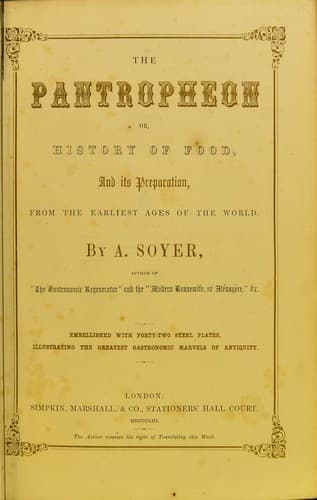
The Pantropheon; Or, History of Food, Its Preparation, from the Earliest Ages of the WorldSoyer, Alexis
History
The Pantropheon; Or, History of Food, Its Preparation, from the Earliest Ages of the World
Soyer, Alexis
Cooking; Food; Gastronomy
Orpheus, Pythagoras, and their sectators--good and humane people as ever
lived--unceasingly recommended in their discourses to abstain from eggs,
in order not to destroy a germ which nature had destined for the
production of chicken.[XVIII-64] Many allowed themselves to be
persuaded, and would have believed it an unpardonable crime if they had
eaten a tiny _omelette_, or boiled eggs.
Many of the most learned philosophers held eggs in a kind of respect
approaching to veneration, because they saw in them the emblem of the
world and the four elements. The shell, they said, represented the
earth; the white, water; the yolk, fire; and air was found under the
shell.[XVIII-65]
In India and Syria, there was less scruple about swallowing a few eggs;
but the hens were devoutly worshipped, because the world is indebted to
them for chickens.[XVIII-66]
The Greeks and Romans, although more reasonable, felt, however, for
eggs a trifling weakness not exempt from superstition. They already made
use of them in their sacrifices, and carried them with great pomp in the
festivals of Ceres.[XVIII-67] For them it was also a symbol of the
universe, and an expiation would not have been complete if some eggs had
not been broken on the altar of the irritated gods.[XVIII-68]
Magicians and sorcerers, who abounded in Rome, established singular
fables with regard to eggs. Livia, the happy consort of Nero, being
_enceinte_, consulted a sorceress, who said to her, “warm in your bosom
a new laid egg until hatched; if a male chicken comes forth, thank the
gods, who will grant you a son.” The empress followed this advice; a
cock chick came, and the princess gave birth to Tiberius.[XVIII-69] This
anecdote circulated in Rome, and all ladies in the same interesting
situation, imitating Livia, amused themselves with hatching chickens.
It appears that the egg played also a most important part in dreams. A
man having dreamed that he had eaten one, went to consult a soothsayer,
who told him that the white signified he would soon have silver, and the
yolk that he would receive gold. The fortunate dreamer really received
very soon afterwards a legacy partly consisting of those two precious
metals. He hastened to thank the diviner, and offered him a piece of
silver. “This is very well for the white,” said the latter, “but is
there nought for the yolk?”[XVIII-70] It is not known whether the heir
was generous enough to understand this _bon mot_.
All these pagan follies are to be accounted for by the doctrine of the
poet Orpheus, who first taught the Greeks that a primitive egg had
produced all other beings;[XVIII-71] a very ancient idea, no doubt,
transmitted to them by the Egyptians, who, as well as the Phœnicians,
Persians, and Chaldeans, represented the world by that symbol.
It is now time to describe eggs as an aliment.
Public-domain text, read in full here on John Shaqi.
Reviews
Reviews
No reviews yet
Be the first to share your thoughts on this work.
Elsewhere in the archive
Join the Discussion
Join the discussion
Sign in to leave a comment or review.
Sign InorCreate an account