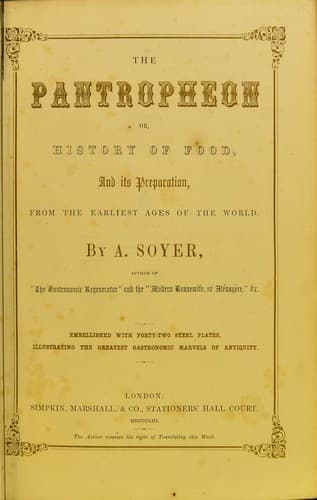
The Pantropheon; Or, History of Food, Its Preparation, from the Earliest Ages of the WorldSoyer, Alexis
History
The Pantropheon; Or, History of Food, Its Preparation, from the Earliest Ages of the World
Soyer, Alexis
Cooking; Food; Gastronomy
_Lesbian Eggs aux Roses._--Pluck the leaves of some roses; take only the
whitest part, and put them into a mortar with garum. Stir a long time;
add half a small glass of gravy; stir and strain; put into this liquor
the brains of four fowls and eight scruples of ground pepper; stir a
long time; add to it eight eggs, half a small glass of wine, and as
much cooked wine, and, lastly, a little oil. Grease well the inside of a
dish, pour the whole into it, and place it over a very slow charcoal
fire. Cook, sprinkle with pepper, and serve.[XVIII-87]
It was a custom, common to every agricultural population throughout
Europe and Asia, to celebrate the new year by eating eggs; and they
formed a part of the presents made on that day. Care was taken to dye
them different colours, particularly red--the favourite colour of the
ancients, and of the Celts in particular.[XVIII-88]
It appears that, formerly, people consumed an astonishing number of eggs
in England on Easter Sunday. We find the following article in an account
of expenses for the king’s household (Edward I.) on the occasion of this
festival:--
“For four hundred and a half of eggs, eighteen pence.”[XVIII-89] At that
epoch eggs were not so dear in England as they are now; nor did kings
fail to eat more of them.
In 1533, a bishop of Paris, authorised by a bull from the Pope, Julius
III., being disposed to permit the use of eggs during Lent, the
parliament took offence, and prevented the execution of the episcopal
mandate. It is this severe abstinence from eggs during Lent which gave
rise to the custom of having a great number of them blessed on Easter
eve, to be distributed among friends on Easter Sunday; whence comes the
expression, “to give Easter eggs.” Pyramids of them were carried into
the king’s cabinet after the high mass. They were gilded, or admirably
painted, and the prince made presents of them to his
courtiers.[XVIII-90]
XIX.
HUNTING.
From the first ages of the world man has passionately loved the exercise
of hunting; the dangers he then encountered inflamed his courage. It was
glorious to struggle with the terrible inhabitants of the forest or the
desert; to conquer them; to bring home their bleeding spoils; to furnish
an heroic name for the songs of poets, and the admiration of posterity.
The sacred writings have handed down to us the name of the first mighty
hunter before the Lord;[XIX-1] they inform us that Ishmael, in the
solitude of Arabia, became skilful in drawing the bow;[XIX-2] and that
David, when yet young, dared to fight with lions and bears.[XIX-3]
Fable, that veiled light of truth, through which it sometimes glimmers,
caused Hercules to be ranked with the gods when he had overthrown the
lion of Nemæa, the hydra of Lerna, and the wild boar of
Erymanthus.[XIX-4]
Public-domain text, read in full here on John Shaqi.
Reviews
Reviews
No reviews yet
Be the first to share your thoughts on this work.
Elsewhere in the archive
Join the Discussion
Join the discussion
Sign in to leave a comment or review.
Sign InorCreate an account