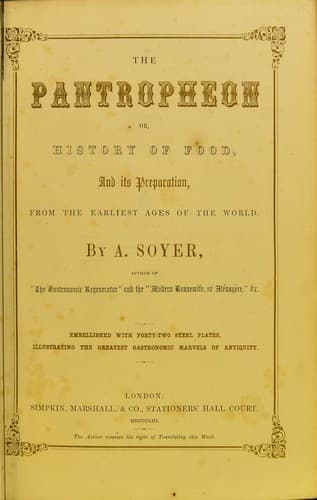
The Pantropheon; Or, History of Food, Its Preparation, from the Earliest Ages of the WorldSoyer, Alexis
History
The Pantropheon; Or, History of Food, Its Preparation, from the Earliest Ages of the World
Soyer, Alexis
Cooking; Food; Gastronomy
Diana descended to the earth, and pursued in the forests the timid
stag.[XIX-5] The Greeks raised altars to her, and the centaur Chiron
learned of her the noble art of venery, which he, in his turn, taught to
illustrious disciples, among whom are mentioned Æsculapius, Nestor,
Theseus, Ulysses, and Achilles.[XIX-6]
Pollux trained the first hunting dogs, and Castor accustomed horses to
follow the track of wild beasts.[XIX-7] From that time, heroes, when
resting from real conquests, sought diversion in games nearly as
formidable, and imitative of their combats, which often placed their
lives in danger. Ulysses, for example, always bore the scar of a wound
inflicted by a wild boar.[XIX-8]
The most grave philosophers, and the most illustrious poets have
bestowed praises on the chase.
Aristotle advised young men to apply themselves to it early.[XIX-9]
Plato finds in it something divine,[XIX-10] Horace looks upon it as
healthful exercise, strengthening to the body, and preparing the way for
glory;[XIX-11] and indeed, this heroic and royal exercise[XIX-12] always
possessed irresistible attraction for the greatest men of antiquity.
The warriors of Homer,[XIX-13] Pelopidas,[XIX-14] Alexander of
Macedon,[XIX-15] Philopœmen,[XIX-16] seemed to derive from it fresh
warlike ardour.
The ancients hunted in the open country, in forests, and in parks.
Mounted on fiery steeds, armed with javelins and long cutlasses, or with
swords and lances,[XIX-17] they excited their indefatigable hounds, and
promised to consecrate to Diana the stag’s horns, or the tusks of the
boar,[XIX-18] which might become their prey.
The Greeks and Romans reared hunting dogs with extreme care, and they
began to make use of them from the age of eight or ten months.[XIX-19]
These animals had names, short, sonorous, and easy to be pronounced,
such as Lance, Flower, Blade, Strength, Ardent, &c.[XIX-20]
The strongest and most courageous came from England and
Scotland;[XIX-21] Crete, Tuscany, and Umbria were the nurseries of the
most expert.[XIX-22] The Gallic dogs surpassed all others by their
agility and astonishing swiftness.[XIX-23]
Females were generally preferred to the males,[XIX-24] either because
they were more docile, or pursued the game with more ardour and
persistence. It may be as well to remark, too, in this place, that the
Greeks thought much more of mares than of horses for chariot
racing.[XIX-25]
The dogs were always chained. Their liberty was only given them at the
moment of starting for the chase.[XIX-26] Their fire and ferocity were
then incredible. They dashed off with fury, and when they succeeded in
coming up with their prey, some would suffer their legs to be cut off
rather than loose their hold. The Indian dogs, trained for lion hunting,
often gave this proof of obstinate and implacable rage.[XIX-27]
Public-domain text, read in full here on John Shaqi.
Reviews
Reviews
No reviews yet
Be the first to share your thoughts on this work.
Elsewhere in the archive
Join the Discussion
Join the discussion
Sign in to leave a comment or review.
Sign InorCreate an account