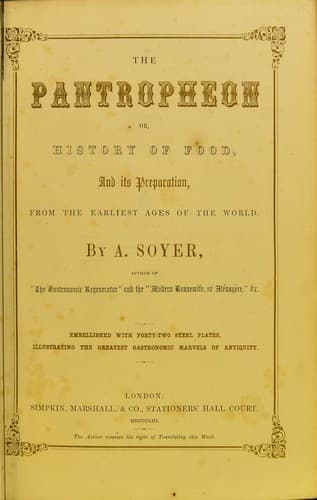
The Pantropheon; Or, History of Food, Its Preparation, from the Earliest Ages of the WorldSoyer, Alexis
History
The Pantropheon; Or, History of Food, Its Preparation, from the Earliest Ages of the World
Soyer, Alexis
Cooking; Food; Gastronomy
The Sicilian even surpassed himself. As soon as the guests had tasted
the enticing delicacies of the first course, the hall echoed with an
unanimous concert of applause, and the proud Amphitryon, intoxicated
with joy, was going to ask that a crown might be presented to his
beloved slave,[XIX-65] when the cook appeared, followed by four
Ethiopians, who gracefully carried a silver vase of prodigious
dimensions, in the shape of a large mortar. This extraordinary dish
contained a wild boar; baskets of dates were suspended to his tusks, and
charming little wild boars, in exquisite pastry, no doubt--for never was
there a more tempting culinary exhalation--artistically surrounded the
enormous animal.[XIX-66] Every voice was hushed; the guests waited in
silence the most profound.[XIX-67] The tables of the second service
were placed round the guests, who raised themselves on the couches with
greedy curiosity. The blacks deposited the precious burden before
another domestic, a skilful carver, who opened the wild boar with
incredible dexterity and precision, and presented to the astonished eyes
of Rullus and his friends a second entire animal, and in this a third;
then came fresh delicacies, all gradually diminishing in size, until, at
length, a delicious little figpecker terminated this series of strange
viands, of which Rome, wondering and astonished, long preserved the
gastronomic remembrance.[XIX-68]
Man seldom prescribes to himself reasonable limits in the vast field of
vanity and ostentation. At first it was thought an enviable boldness to
have dared to serve an entire boar of a large size. Every one did the
same thing, and at length it became quite common. It was necessary then
to do better. One thought of having three at the same time; another had
four; and soon the extravagant--and they were not few--caused eight wild
boars _à la Troyenne_ to appear at a single repast.[XIX-69] The
Macedonian, Caranus, a man of spirit and of merit, placed himself at
once on an eminence which baffled rivalry. He invited twenty guests to
his wedding, and he had twenty wild boars served.[XIX-70]
It must be confessed that such magnificence rather resembles folly; but,
alas! has not every nation its failings? Besides, the flesh of the wild
boar enjoyed an astonishing reputation in Rome and Greece,[XIX-71] and
no one could, with credit to himself, receive his friends at his table
without presenting them with the fashionable dish,--the animal appointed
by nature to appear at banquets.[XIX-72]
At length, however, they began to tire of this enormous dish; they
divided it into three portions, and the middle piece obtained the
preference.[XIX-73] Ultimately they served only the fillet and head; the
latter of which was more particularly esteemed by the Romans.[XIX-74]
The Greeks tried their appetites by tasting the liver, which was served
at the first course.[XIX-75]
Public-domain text, read in full here on John Shaqi.
Reviews
Reviews
No reviews yet
Be the first to share your thoughts on this work.
Elsewhere in the archive
Join the Discussion
Join the discussion
Sign in to leave a comment or review.
Sign InorCreate an account