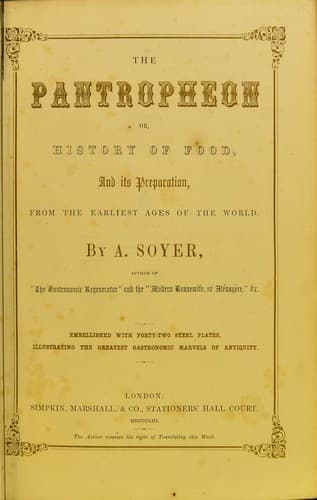
The Pantropheon; Or, History of Food, Its Preparation, from the Earliest Ages of the WorldSoyer, Alexis
History
The Pantropheon; Or, History of Food, Its Preparation, from the Earliest Ages of the World
Soyer, Alexis
Cooking; Food; Gastronomy
“A very small consumption is made of the old wild boar; the flesh is
hard, dry, and heavy; the head only is good. The young wild boar is a
fine and delicate game, also, when a year old. The ancients submitted
those they could take away from their mother to castration, and left
them afterwards to run about the woods, where these animals became
larger than the others, and acquired a savour and flavour which made
them preferable to the pigs we rear.”--SONNINI.
THE HARE.
Plutarch contends that the Jews abstained from eating the hare, not
because they thought it unclean, but because it resembled the ass, which
they revered.[XIX-86] This is only a pleasantry on the part of the
celebrated writer, with no other foundation than the fabulous tale of
the grammarian Apion, who asserts in his book against the Jews that they
preserved in Jerusalem an ass’s head, which they adored.[XIX-87] We know
that a sanitary motive was the cause of this animal being interdicted to
the Israelites;[XIX-88] and it has been also remarked that the ancient
Britons abstained from it.[XIX-89]
This mammifer, everywhere very common, swarmed in the East, if we are to
believe Xenophon, who saw a great number of them when marching with his
troops to join young Cyrus.[XIX-90] Greece was abundantly stocked with
them:[XIX-91] the inhabitants of islands of the Ægean sea had more than
once to deplore the ravages which hunger caused these timid animals to
commit, and whose fecundity they cursed.
Hegesander relates that, under the reign of Antigonus, an inhabitant of
the island of Anaphe brought two hares into the neighbourhood. Their
posterity became so numerous that the people were obliged to implore the
gods to preserve the harvest, and to annihilate their formidable
enemies. As the immortals turned a deaf ear to these complaints,
recourse was had to Apollo alone, and the Pythonissa deigned to return
this oracle: “Train hunting dogs, and they will exterminate the
hares.”[XIX-92] The advice was good, and deemed worthy of being adopted.
The Greeks esteemed highly the flesh of this quadruped, which was served
roasted, but almost bleeding,[XIX-93] or made into delicious
pies,[XIX-94] much in vogue in the time of Aristophanes.[XIX-95]
Hippocrates had, however, forbidden the use of it. “The hare,” said he,
“thickens the blood, and causes cruel wakefulness;”[XIX-96] but
epicurism will always think lightly of Hygeian precepts which do not
accord with its own ideas. At all events, Galen was not of the same
opinion as his colleague,[XIX-97] and Galen must be right.
Public-domain text, read in full here on John Shaqi.
Reviews
Reviews
No reviews yet
Be the first to share your thoughts on this work.
Elsewhere in the archive
Join the Discussion
Join the discussion
Sign in to leave a comment or review.
Sign InorCreate an account