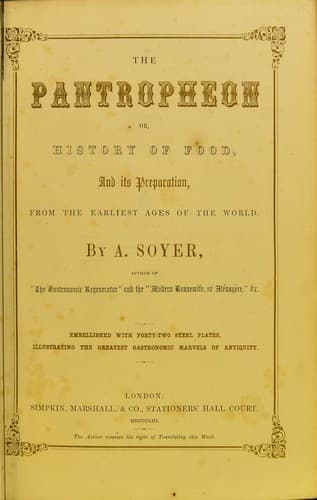
The Pantropheon; Or, History of Food, Its Preparation, from the Earliest Ages of the WorldSoyer, Alexis
History
The Pantropheon; Or, History of Food, Its Preparation, from the Earliest Ages of the World
Soyer, Alexis
Cooking; Food; Gastronomy
Some modern nations--the French among others--formerly eat the heron,
crane, crow, stork, swan, cormorant, and bittern; the first three
especially were highly esteemed, and Taillevant, cook of Charles VII.,
teaches us how to prepare these meagre, tough birds. Belon says that, in
spite of its revolting taste when unaccustomed to it, the bittern is,
however, among the delicious treats of the French.[XX-5] This writer
asserts also that a falcon, or a vulture, either roasted or boiled, is
excellent eating; and that if one of these birds happened to kill itself
in flying after the game, the falconer instantly cooked it. Liebaut
calls the heron a royal viand!
These same men who eat vultures, herons, and cormorants, did not touch
young game: they thought it indigestible; and, for instance, abstained
from leverets and partridges.
The internal parts being the first to corrupt, the ancients carefully
drew the game they wished to preserve. That done, they filled the inside
with wheat or oats, and then placed it in the midst of a heap of flour
or grain, with the feathers or hair on.
Thus protected from the contact of the air or insects, the game kept
remarkably well.
THE PHEASANT.
The Argonauts discovered this magnificent bird on the shores of Phasis,
a celebrated river of Colchis, and introduced it into Greece, where it
was unknown.[XX-6] This tradition, sung by the poets,[XX-7] has only met
with one contradictor, Isidorus,[XX-8] who pretends that the pheasant is
a native of an island of Greece, called Phasis.
All nations soon hastened to receive it with the favour its rich plumage
and the exquisite delicacy of its flesh deserve. Carried in cages
composed of precious wood, it adorned the triumphal march of Ptolemy
Philadelphus, at his entry into Alexandria.[XX-9] Ptolemy Evergetes,
successor to that prince, caused pheasants to be sent from Media, which
he destined for his aviary; and he never eat them, so much did he dread
the idea of diminishing their number.[XX-10] But, alas! custom and time,
those jealous enemies of the greatest glories, eventually put an end to
that. The unfortunate creature was stripped of its feathers and roasted;
gluttony, an insatiable monster that never says “enough,” rejoiced at
being able to count it among the number of its conquests. The Greeks had
coops for pheasants as we have for fowls, not to please the eye, but to
ornament the table,[XX-11] and a foolish prodigality caused a whole
pheasant to be served to each guest in those luxurious repasts which the
Athenians gave to display their pomp and ostentatious
hospitality.[XX-12]
Among the Romans, Pliny is the first (or we are mistaken) who mentions
this bird, then very uncommon in Italy, since they went in quest of it
to the banks of the Phasis.[XX-13] Its rarity did not prevent Vitellius
from having a _ragoût_ of pheasants’ brains,[XX-14] mixed with other
viands of an unheard-of delicacy, in the immense dish called by him “the
Shield of Minerva.”[XX-15]
Public-domain text, read in full here on John Shaqi.
Reviews
Reviews
No reviews yet
Be the first to share your thoughts on this work.
Elsewhere in the archive
Join the Discussion
Join the discussion
Sign in to leave a comment or review.
Sign InorCreate an account