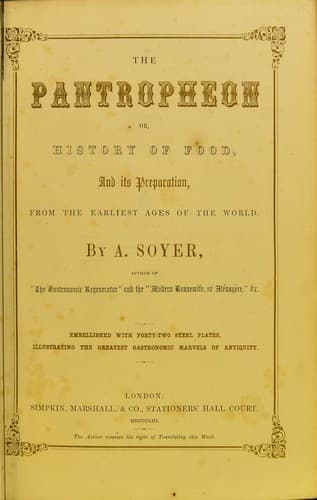
The Pantropheon; Or, History of Food, Its Preparation, from the Earliest Ages of the WorldSoyer, Alexis
History
The Pantropheon; Or, History of Food, Its Preparation, from the Earliest Ages of the World
Soyer, Alexis
Cooking; Food; Gastronomy
“They cut off the four feet of the animal, and made in the earth a hole
about three feet square. This was filled with live charcoal, and,
covering the whole with very dry wood, a large fire was kept up during
part of the night. When they thought that the hole was hot enough, it
was emptied: a Hottentot then placed within it the four feet of the
animal, covered them with hot ashes, and then with charcoal and small
wood; and this fire was left burning until the morning. * * * My
servants presented me at breakfast with an elephant’s foot. It had
considerably swelled in the cooking; I could hardly recognise the shape,
but it appeared so good, exhaled so inviting an odour, that I hastened
to taste it. It was a dish for a king. Although I had often heard the
bear’s foot praised, I could, not conceive how so heavy, so material an
animal as the elephant, could furnish a dish so fine and delicate. * * *
And I devoured, without bread, my elephant’s foot, while my Hottentots,
seated around me, regaled themselves with other parts, which they found
equally delicious.”[XIX-117]
The Romans never evinced fondness for the flesh of the elephant. This
animal, with its gigantic proportions and rare intelligence, was found
to be so amusing to the nation of kings, when dancing on the tight
rope,[XIX-118] or in the terrible combats of the Circus,[XIX-119] that
they hardly thought of roasting it, or making it into _fricassees_. We
cannot, however, affirm that the gastronomic eccentricity of some Roman
epicure did not dream of a monstrous feast, in which he may have offered
to his guests an elephant _à la Troyenne_ on a silver dish, made
purposely for the occasion.
XX.
FEATHERED GAME.
Moses permitted his people to eat game, with the exception of birds of
prey and some other species whose flesh appeared to him hard and
unwholesome.[XX-1]
The Egyptians piously offered to their priests the most delicate birds,
which they willingly accepted, and eat, in order not to weaken their
intelligence by the use of more simple and heavy food.[XX-2]
Among the Greeks, at the commencement of the repast, little birds were
served roasted, on which was poured a boiling sauce, composed of scraped
cheese, oil, vinegar, and silphium.[XX-3]
Feathered game appeared in Italy only at the second course. The Romans
were very partial to it, and many epicureans, possessing strange tastes,
found means to ruin themselves by eating pheasants and flamingoes.
The celebrated comedian, Æsopus, whom Cicero thought worthy of being his
master in the art of declamation, had one day the fancy to regale
himself with a dish of birds, the whole of which, when living, had both
learned to sing and speak.[XX-4] This gluttony of a new kind cost him
very dear, and the supper of the barbarian was not any the better for
it.
Public-domain text, read in full here on John Shaqi.
Reviews
Reviews
No reviews yet
Be the first to share your thoughts on this work.
Elsewhere in the archive
Join the Discussion
Join the discussion
Sign in to leave a comment or review.
Sign InorCreate an account