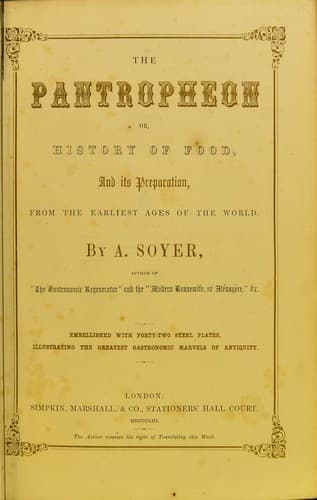
The Pantropheon; Or, History of Food, Its Preparation, from the Earliest Ages of the WorldSoyer, Alexis
History
The Pantropheon; Or, History of Food, Its Preparation, from the Earliest Ages of the World
Soyer, Alexis
Cooking; Food; Gastronomy
VARRO’S MAGNIFICENT AVIARY.--Adjoining his villa was a part of the
house called the Ornithon, or the Aviary, of which some ruins are
still remaining, between the two small rivers Vinius and Casinus,
but can hardly be made out. More, perhaps, was in existence when
the famous architect and antiquarian, Pierre Ligorio, drew the plan
and profile more than 200 years ago. This drawing of Plate IX. is
conformable with Varro’s own description, who says that: “At the
entrance there are two porticoes, or two large cages (in the Plate
these are omitted for want of space); they are buildings with
colonnades all round, on the top and sides there are nettings
spread to prevent the escape of the birds. The entrance to the
yards is between the two pavilions; two basins, long and wide, are
alongside of the court-yard on the right and left of it; from them
you pass to the grand double colonnade, the first circumference of
which is of stone, and the second of pine; the distance from each
other is five feet, and the whole of this middle space is filled
with birds, which are prevented from escaping by small fillets all
over the top and sides. There are, between the columns, like a
small theatre, rails, like steps, put forward for the birds to
perch upon. There are birds of various species, particularly
singing birds, such as nightingales and blackbirds; a small canal
supplies them with fresh water, and they are fed from under the
netting. Facing the pedestals of the column is a stone, raised one
foot nine inches above the quay, and that is elevated two feet
above the level of the water; its width is five feet, to enable the
visitor to walk round. At the lower part of the quay, on the
water-side, there are holes practised where the ducks can retire.
In the centre of the large basin, about 200 feet in diameter, is a
small island, bordered by a small colonnade, under which Varro
treats his friends; in the middle, a round table, which a servant
turns on a pivot, so that in succession the guests are supplied
with dishes, plates, cups, and goblets. There is seen also an
hemisphere, where the star Lucifer turns in the day, and Hesperus
at night; both mark the hour, and are variable; on the same
hemisphere the winds, to the number of eight, are marked with a
hand that is always moving as the wind changes, the same as the
clock of Cyprestus, at Athena.”
The drawing of this Aviary is beautiful. It appears that Pierre
Ligorio followed Varro’s description; at all events, the drawing of
this Plate perfectly agrees with it.
[Illustration: _Pl. 9._]
Heliogabalus eat only the brains of these birds.[XX-54] This dish
appeared to him most excellent, for it was very costly.
Public-domain text, read in full here on John Shaqi.
Reviews
Reviews
No reviews yet
Be the first to share your thoughts on this work.
Elsewhere in the archive
Join the Discussion
Join the discussion
Sign in to leave a comment or review.
Sign InorCreate an account