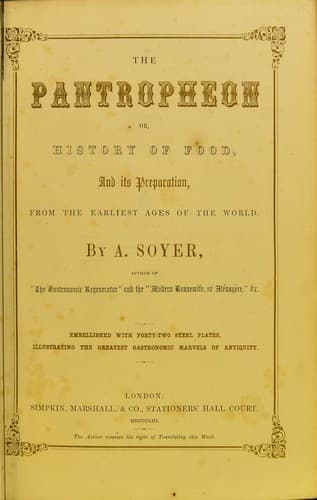
The Pantropheon; Or, History of Food, Its Preparation, from the Earliest Ages of the WorldSoyer, Alexis
History
The Pantropheon; Or, History of Food, Its Preparation, from the Earliest Ages of the World
Soyer, Alexis
Cooking; Food; Gastronomy
The extreme delicacy of this volatile, which poetical connoisseurs have
celebrated in their verses,[XX-55] recommends it to those with weak
stomachs and to convalescents. Pompey being ill, his physician ordered
him a thrush, but it was impossible to find one in Rome. Some one
advised the celebrated general to apply to Lucullus, who fattened them
throughout the year. “What,” cried Pompey, ill-humouredly, “shall I have
to thank Lucullus’s pompous luxury for life!” He refused to eat the
thrush, and he recovered.[XX-56]
THE BLACKBIRD.
What has been already said of the thrush precludes the necessity of
writing much on the blackbird, for both these kinds of birds were
equally dear to the gastronomists of Greece and Italy.[XX-57] They were
fattened in the same manner,[XX-58] served on the same tables. The
blackbird, in fact, like the thrush, re-established the strength and
health of the rich.[XX-59] The poor were compelled to have recourse to
less expensive remedies.
“The flesh of the blackbird, so delicate in the time of gathering
grapes, acquires at that period a savour which makes it as precious as
the quail, but becomes bitter when they feed on the juniper berries, the
ivy, or other similar fruits. Some medicinal properties are attributed
to it; the oil in which the blackbirds have been cooked is recommended
to persons afflicted with sciatica: and the soil of these birds,
dissolved in vinegar, is, we are informed, a certain specific for
removing the freckles of the face or spots on the skin.”--VIEILLOT.
In 1468, Louis XI. ordered one of his authorised ruffians, named
Perdriel, to seize all the tame blackbirds he could find in Paris. These
poor birds were sent to Amboise, where a register was kept of what they
said or sung. It appears that the king intended to punish those citizens
of his capital who taught these innocent volatiles to repeat abuse of
the sovereign, after which he would have wrung the necks of the too
intelligent birds. Louis XI. could not carry out this singular idea,
because he himself was shortly after the Duke of Burgundy’s prisoner at
Péronne. Blackbirds and citizens had a narrow escape.[XX-60]
THE STARLING.
Drusus and Britannicus, sons of the Emperor Claudius, had a starling
which spoke admirably the Greek and Latin. Alone he studied his lessons,
and afterwards recited them to the astonished princes.[XX-61] Science
protected the learned bird from the fate reserved by the Greeks and
Romans for the rest of its family, less distinguished by their erudition
than by their culinary qualities. Starlings, roasted in the kitchens,
honourably associated with partridges, blackbirds, and thrushes,[XX-62]
and the disciples of Galen recommended them to their patients, who
willingly submitted to so nourishing and light a food.[XX-63]
THE FLAMINGO.
Public-domain text, read in full here on John Shaqi.
Reviews
Reviews
No reviews yet
Be the first to share your thoughts on this work.
Elsewhere in the archive
Join the Discussion
Join the discussion
Sign in to leave a comment or review.
Sign InorCreate an account