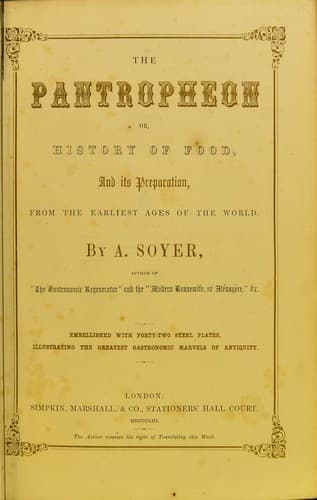
The Pantropheon; Or, History of Food, Its Preparation, from the Earliest Ages of the WorldSoyer, Alexis
History
The Pantropheon; Or, History of Food, Its Preparation, from the Earliest Ages of the World
Soyer, Alexis
Cooking; Food; Gastronomy
In several countries it is known at what period the carp was
naturalized. Peter Marshall brought it to England in 1514; Peter Oxe to
Denmark in 1560. A few years after, it was introduced into Holland and
Sweden. The fecundity of this fish is surprising; no less than 621,600
eggs were found in a carp weighing nine pounds; and it is very
long-lived. Several have been seen in the moats of the castle of
Ponchartrain, which were proved to be 150 years old. Carp are capable of
acquiring considerable dimensions. The most gigantic on record was that
caught at Bisshofs-hause, near Frankfort on the Oder; it weighed 70
lbs.[XXI-140]
EEL-POUT.
The liver of the eel-pout (also known by the names, _lota_, _lote_, and
_lotus_) is particularly large, and so delicate that a certain Countess
of Beuchlingen squandered a large portion of her income to gratify her
taste for them.[XXI-141] That lady, worthy, by her refined and antique
taste, of the proudest period of Roman extravagance, was, perhaps, not
aware that the most fastidious epicureans of Italy, enthusiastic
admirers of the liver of this fish,[XXI-142] had it served with a sauce
composed of vinegar, grated cheese, and garlic; to which they added
leeks and onions, chopped fine.[XXI-143]
TROUT.
Elian speaks of a fish found in the river Astræus, in
Macedonia,[XXI-144] which Gesner believed to be identical with the
trout. It does not appear, however, that the Greeks knew the real value
and merit of this fish; but on the other hand, the Romans assigned to it
the foremost rank, next to the sturgeon, red mullets, and the sea-eel,
especially when they had been fattened in the thick waters of the Tiber,
on the very spot where the labridans acquired their plumpness and
value.[XXI-145]
The trout was dressed like the preceding fish.
GOLD FISH.
This fish, dear to the Greeks,[XXI-146] had the honour of giving its
name to the celebrated icythyophagist, Sergius, who was passionately
fond of it, and who took the name Orata (from _Aurata_--gold fish), to
preserve in his family the remembrance of his gluttony or of his
affection.[XXI-147] His compatriots, the Romans, highly valued the gold
fish,[XXI-148] and sought with eagerness those which had fed on the
shell fish of the lake of Lucrin[XXI-149]--that precious reservoir
between Baiæ and Cumæ, which never deceived the hopes of the
gastronomist, nor the greedy expectations of the fishermen.[XXI-150]
The gold fish was served with a gravy composed of pepper, alisander,
carrots, wild marjoram, rue, mint, myrtle leaves, and yolk of eggs;
mixed with honey, vinegar, oil, wine, and garum.[XXI-151] The slow
cooking of these various ingredients gave them the required
homogeneousness.
WHITING.
Public-domain text, read in full here on John Shaqi.
Reviews
Reviews
No reviews yet
Be the first to share your thoughts on this work.
Elsewhere in the archive
Join the Discussion
Join the discussion
Sign in to leave a comment or review.
Sign InorCreate an account