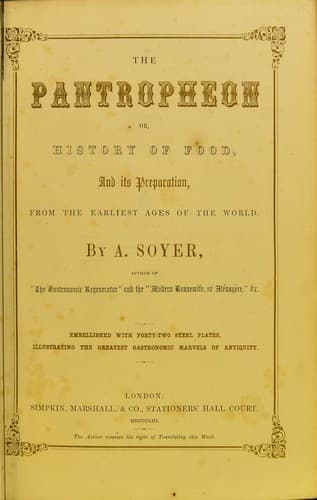
The Pantropheon; Or, History of Food, Its Preparation, from the Earliest Ages of the WorldSoyer, Alexis
History
The Pantropheon; Or, History of Food, Its Preparation, from the Earliest Ages of the World
Soyer, Alexis
Cooking; Food; Gastronomy
The flesh of this _gadus_ is so light that, according to an old French
proverb, the “_Merlans mangée ne pèsant non plus dans l’estomac que
pendus à la ceinture_.”[XXI-152] “Whitings weigh no more when eaten than
when hung to the girdle.” Nevertheless, the Greeks did not think much of
it, and they said that the whiting was only good for those who could not
obtain more delicate fish.[XXI-153]
The Romans, less severe or not quite so particular, cooked their
whitings with a sauce composed as follows:--put with the fish, in a
stewpan, some garum, chopped leeks, cummin, savory, and a sufficient
quantity of cooked wine, and some wine slightly diluted; cook it on a
slow fire.[XXI-154]
COD FISH.
The cod fish supplied the ancients with the most exquisite dish next to
the sturgeon.[XXI-155] The only fault found with it was, that it cost
less than others. The Greek cooks sprinkled it with grated cheese,
moistened with vinegar; then they threw over it a pinch of salt and a
few drops of oil.[XXI-156] Persons with delicate stomachs did not
scruple to partake of this aliment, which Galen warranted as being
excellent.[XXI-157]
The average size of this fish is about three feet in length; but some
are found of ten feet. The common weight is fifteen pounds, and some
have been seen weighing 60lbs. Leuwenhoek has said that 9,344,000 eggs
had been found in one fish. It is probable he made a mistake, as a cod
fish of our days, weighing 50lbs., produced only 3,686,000 eggs--a
number sufficiently prodigious, and which shows pretty well its great
fecundity.[XXI-158]
It is supposed that the discovery of the great and small banks of cod
fish is due to the Basque fishermen, who arrived there in pursuit of
whales, one hundred years before Columbus’ voyage. Others give that
honour to James Cartier, a native of Falkland Islands.
“As early as the 14th century, the English and the inhabitants of
Amsterdam busied themselves with cod fishing; and later, the Irish,
Norwegians, French, and Spaniards competed with them more or less
successfully. In 1533, Francis I. having sent J. Verrazzano, and
afterwards, Jacques Cartier, to explore the neighbourhood of
Newfoundland, the French fishermen followed them, and brought back also
this fish from those distant countries in the beginning of the 16th
century.
Public-domain text, read in full here on John Shaqi.
Reviews
Reviews
No reviews yet
Be the first to share your thoughts on this work.
Elsewhere in the archive
Join the Discussion
Join the discussion
Sign in to leave a comment or review.
Sign InorCreate an account