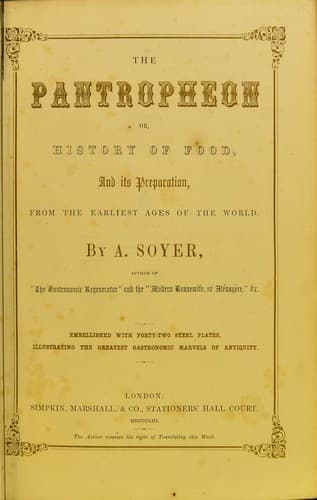
The Pantropheon; Or, History of Food, Its Preparation, from the Earliest Ages of the WorldSoyer, Alexis
History
The Pantropheon; Or, History of Food, Its Preparation, from the Earliest Ages of the World
Soyer, Alexis
Cooking; Food; Gastronomy
The inhabitants of Italy, free from this singular superstition, cleaned
the loaches, left them some time in oil, then placed them in a saucepan
with some more oil, garum, wine, and several bunches of rue and wild
marjoram. Then these bunches were thrown away, and the fish was
sprinkled with pepper at the moment of serving.[XXI-207]
GUDGEON.
The gudgeon--thought excellent by every one, but which no one
mentions--appeared with honour in the most magnificent repasts at
Athens.[XXI-208] At Rome, it was served fried, at the beginning of
supper;[XXI-209] and it disposed the guests to attack boldly the
culinary _corps de réserve_, which took up the position as soon as the
skirmish with the gudgeon was over.
“This fish is in abundance, principally in France and Germany; it is
very good, and easily digested. They are served either fried or stewed;
when done as last-mentioned, they must be drawn and wiped dry, put in a
flat stewpan with butter, salt, pepper, good red wine, spring onions,
mushrooms, shalots, thyme, bay leaves and basil--these last plants
chopped very fine; stew the whole a quarter of an hour, and
serve.”--BOSC.
HERRING.
Herrings were unknown in Greece and Rome. Bosc says it is a manna that
nature doubtless reserved for the northern nations, which they, however,
have only turned to account in modern times.
The first herring fishery known in Europe was on the coast of Scotland;
but that nation knew not how to profit by the treasure that the sea
offered them. All the Scotch historians mention this fishery, the
produce of which was bought by the Dutch. This transaction took place
under the reign of King Alfred, about the year 836.
After some time the Scotch quarrelled with the Dutch, who undertook the
herring fishery themselves. As they caught a great many more than they
could consume, they salted them, and sold them in foreign countries.
Such was the origin of that immense commerce, which had its rise,
according to Eidous, about the year 1320, a short time after the Teutons
had established themselves in the Baltic.
It is said that we owe the art of salting and barreling herrings to a
Dutch fisherman, named William Beuckels, who died in 1449. The Dutch
nation raised a mausoleum to his memory; and it is asserted that Charles
V., who visited it in 1536, eat a herring upon it to render homage to
the author of a precious discovery.
In the year 1610, Sir Walter Raleigh gave a statistical account of the
commerce carried on by the Dutch in Russia, Germany, Flanders, and
France, with the herrings caught on the coasts of England, Scotland,
and Ireland. The sale of this fish amounted, in one year, to the sum of
£2,650,000.
It has been erroneously thought that the herring was the _halec_, or,
_alec_, of the Romans. This name was given by them to a kind of
brine;[XXI-210] it was not the name of any particular fish.
Public-domain text, read in full here on John Shaqi.
Reviews
Reviews
No reviews yet
Be the first to share your thoughts on this work.
Elsewhere in the archive
Join the Discussion
Join the discussion
Sign in to leave a comment or review.
Sign InorCreate an account