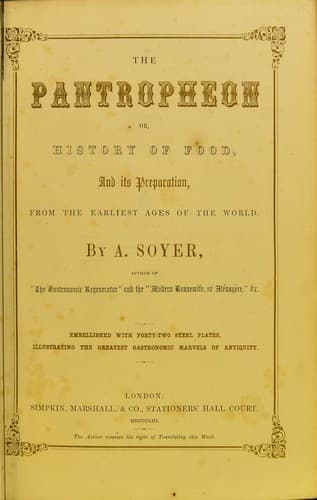
The Pantropheon; Or, History of Food, Its Preparation, from the Earliest Ages of the WorldSoyer, Alexis
History
The Pantropheon; Or, History of Food, Its Preparation, from the Earliest Ages of the World
Soyer, Alexis
Cooking; Food; Gastronomy
But, as we have before remarked, the magiric art always survives
revolutions and ruin of empires. Modern Italy inherited the wrecks of
Roman cookery, and, thanks to her, Europe is at the present day
acquainted with the delights of good cheer, and the charm of joyous
repasts.
Under the reign of Louis XII. there arose a company of sauce
manufacturers, who obtained the exclusive privilege of making sauces.
Their statutes (1394) inform us that the famous sauce _à la cameline_,
sold by them, was to be composed “of good cinnamon, good ginger, good
cloves, good grains of paradise, good bread, and good vinegar.” The
sauce, _Tence_, was to be made of “good sound almonds, good ginger, good
wine, and good verjuice.” We find in Taillevant, the celebrated cook of
Charles V. and Charles VI., besides the _cameline_, _l’eau bénite_ (holy
water)--the sauce for pike, _le saupiquet_, _le mostechan_, _la
gélatine_, _la sauce à l’alose_, _au moût_, that of milk-garlic, cold,
red, and green sauces, _sauce Robert_, _Poitevine_, _à Madame rappée_,
and _à la dodine_.
Platina, a Latin author of the 15th century, speaks of other sauces, in
the composition of which sugar was frequently employed, according to the
proverb of those times: “Sugar never spoiled sauce.”
In the middle ages, poultry, butchers’ meat, and roast game, were never
eaten dry, as they are now, any more than fried fish. There were
different sauces for all those dishes, and even for the different parts
of each animal. The cooks of those days strove to acquire a reputation
by inventing strange and grotesque sauces, which had no other merit than
that of being surprising and difficult to make, as, for example: “eggs
cooked on the spit,” “butter fried or roasted.” &c.[XXII-31]
We recognize in some of our most common _ragoûts_, those of which our
ancestors were so fond in the middle ages, such as the _bœuf à la
mode_, _à la persillade_, _au vinaigre et persil_, _le miroton de
bœuf_, _veau percé de gros lard_, _fricassée de poulet_, _blanquette
de veau rôti_; but we have lost the _pot-pourri_, composed of beef,
veal, mutton, bacon, and vegetables, and the _galimafrée_, a kind of
_fricassée_ of fowl, seasoned with wine, verjuice, and spices, and
thickened with the famous sauce _cameline_.[XXII-32]
The cooks frequently placed on their masters’ tables _ragoûts_ and other
dishes borrowed from foreign nations. They had a German _brouet_, a
Flemish _chaudeau_, eggs _à la Florentine_, and partridges _à la
Catalane_. They knew the _olla_--a mixture of all sorts of vegetables
cooked with different kinds of meats, which we owe to the Spaniards, as
well as the _ragoût_ of fowl, called _à la Chipolata_, and the
_keneffes_--a kind of forced-meat balls made of bread and meat, to which
the Germans are very partial, and the _pilau_--a dish of mutton, fowl,
and rice, borrowed from the Turks.[XXII-33]
Public-domain text, read in full here on John Shaqi.
Reviews
Reviews
No reviews yet
Be the first to share your thoughts on this work.
Elsewhere in the archive
Join the Discussion
Join the discussion
Sign in to leave a comment or review.
Sign InorCreate an account