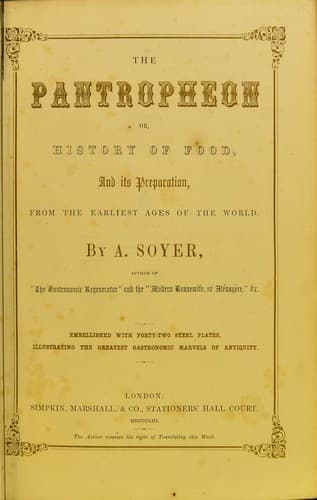
The Pantropheon; Or, History of Food, Its Preparation, from the Earliest Ages of the WorldSoyer, Alexis
History
The Pantropheon; Or, History of Food, Its Preparation, from the Earliest Ages of the World
Soyer, Alexis
Cooking; Food; Gastronomy
There are four sorts of salt which are employed to season dishes,
obtained either from the evaporation of sea water, from certain lakes or
salt marshes, and also from saliferous sources drawn out of the bosom of
the earth in compact masses. Its particular savour is well known; it is
soluble in water, and easily becomes damp. In the scientific language,
this substance is called hydrochlorate of soda.
BRINE.
This was water in which bay salt had been dissolved. At Rome, it was
served at table to be mixed with the meat precisely in the same manner
as we serve salt in salt-cellars. The Romans plunged in this muria any
fish or meat they might wish to preserve.[XXIII-13]
Strong _muria dura_ was water so completely saturated with bay salt,
that no more could be dissolved in it.[XXIII-14] Olives were washed in
it.
The brine most sought after was that of Antibes, of Thurium, and of
Dalmatia.[XXIII-15] It was prepared with the blood and other juices
which, after death, escaped from the tunny fish,[XXIII-16] mixed with
garum, which rendered it more fluid and less expensive.
At the end of the repast, enigmas were often proposed to the guests.
Some delicious dish served as a reward to those who were fortunate
enough to guess them; the others were compelled to pour _muria_ into
their drink, and swallow a cup-full without taking breath.[XXIII-17]
DIGESTIVE SALTS.
The Romans were enormous eaters. Apicius, who was better aware of it
than any one, imagined providing against those accidents to which his
countrymen did not fear to expose themselves once every day, by offering
to them a preparation which our habits of sobriety would, doubtless,
render useless at the present day; but which the curious will not be
sorry to discover in these sketches of antique gastrophagy. Take a pound
of common salt, which torrefy and pulverize; mix it with three ounces of
white pepper, two ounces of ginger, an ounce of lamoni, an ounce and a
half of thyme, as much of celery seed, three ounces of wild marjoram, an
ounce and a-half of rocket seed, three ounces of black pepper, an ounce
and a-half of holy thistle, two ounces of hyssop, two ounces of
spikenard, two ounces of parsley, and two ounces of
anise-seed.[XXIII-18]
Take a small quantity of these salts after a too plentiful dinner; and
the stomach will immediately defy the most imminent indigestion.
GARUM.
When we have read all that has been written by the ancients on this
famous preparation, we become convinced, in spite of the obscurities
and continual contradictions of commentators, that if garum is no
longer manufactured in the present day, it is not on account of the
impossibility we find in discovering the recipe of the Greeks and
Latins, but solely because this rather strange brine has not the same
charm for us that it had for them. Let us, however, scan the
authorities.
Public-domain text, read in full here on John Shaqi.
Reviews
Reviews
No reviews yet
Be the first to share your thoughts on this work.
Elsewhere in the archive
Join the Discussion
Join the discussion
Sign in to leave a comment or review.
Sign InorCreate an account