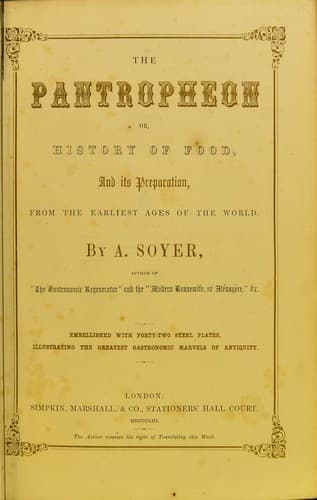
The Pantropheon; Or, History of Food, Its Preparation, from the Earliest Ages of the WorldSoyer, Alexis
History
The Pantropheon; Or, History of Food, Its Preparation, from the Earliest Ages of the World
Soyer, Alexis
Cooking; Food; Gastronomy
The Greeks called the shrimp _garos_, the Romans _garus_: it may hence
be supposed that garum had originally for basis the flesh of shrimps, if
Pliny had not taken the trouble to inform us of the fact.[XXIII-19] It
was afterwards composed of other fish, but it always retained the name
which recalled its origin.[XXIII-20] In like manner the signification of
certain words is now applied to things quite different from the original
type: chicory, or succory, is received under the mask of coffee: a
certain pottage boldly usurps the honours due exclusively to turtle
soup. Nothing more easy than to multiply these examples of catachreses:
there are few figures which have become so common.
Well, then, they macerated the intestines of fish in water, saturated
with salt, until putrefaction began to show itself; they then added
parsley and vinegar.[XXIII-21]
A thick garum was also frequently obtained, by allowing the entrails and
other parts, generally thrown away, to liquefy in salt.[XXIII-22]
In the time of Pliny, mackerel[XXIII-23] was preferred, of which they
employed either the gills and intestines, or only the blood, directly
the fish left the water,[XXIII-24] and while yet living. They thus
obtained a precious liquid, and which the care necessary for its
production rendered so dear, that eight pints of it cost no less than
from fifteen to twenty pounds.[XXIII-25]
This expensive garum was especially esteemed when it came from Spain: it
was then called “garum of the allies”--_garum sociorum_--because it was
received from a nation allied with the Romans;[XXIII-26] or, again,
perhaps in allusion to the “band of gluttons,” of Rome, a sort of
fraternity of free-livers, who made great use of it.[XXIII-27]
The blood and entrails of the tunny fish, mixed with salt in a vase,
produced also a most elaborate garum. A hole was made in the vessel at
the expiration of two months, and the rich seasoning flowed from
it.[XXIII-28]
This brine became exquisite, and obtained an exorbitant price when made
from the liver of anchovies macerated in vinegar, pepper, salt, parsley,
garlic, white wine, and sweet herbs.[XXIII-29] But Apicius attained at
the first step the apogee of refinement of the most sensual gluttony, by
inventing garum made from the liver of red mullet.[XXIII-30] What we
have already said elsewhere with regard to this fish will enable the
reader to appreciate the value of this new preparation.
Public-domain text, read in full here on John Shaqi.
Reviews
Reviews
No reviews yet
Be the first to share your thoughts on this work.
Elsewhere in the archive
Join the Discussion
Join the discussion
Sign in to leave a comment or review.
Sign InorCreate an account