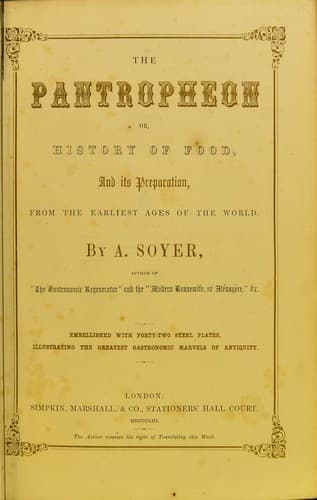
The Pantropheon; Or, History of Food, Its Preparation, from the Earliest Ages of the WorldSoyer, Alexis
History
The Pantropheon; Or, History of Food, Its Preparation, from the Earliest Ages of the World
Soyer, Alexis
Cooking; Food; Gastronomy
causes it to emit burning yet sweet emanations.[XXIV-19]
Here is a more modest recipe for a cake; but then it does not claim the
paternity of an emperor. However, Cato brought it much into fashion, for
the wise Cato often busied himself in the science of cookery, for which
reason he is greatly worthy of esteem. Well, we recommend to the reader
the _Libum_ of that philosopher, who indicates the manner of preparing
it:--
“Crush,” he says, “two pounds of cheese; mix with it a pound of rye
flour, or, in order to render it lighter, throw in merely half a pound
of wheat flour and an egg. Stir, mix, and work this paste; form of it a
cake which you will place on leaves, and cook in a tart dish on the hot
hearth.” This libum was much esteemed about twenty centuries ago; in
honour of Cato may it again be brought to light, if not completely
unworthy of our attention.[XXIV-20] Could we not also rehabilitate the
reputation of the most celebrated of ancient pies, the _Placenta_, which
so delighted mankind, and by which the gods even allowed their fury to
be appeased?[XXIV-21] Renowned writers have granted it the authority of
their praise;[XXIV-22] and the illustrious geoponist, already cited,
describes with lengthened complaisance the manner of preparing this
important dish:--
“Place, on one side, two pounds of rye flour, which will serve to form
the foundation, on which must be placed biscuits, formed of crisp paste;
on the other, put four pounds of wheat; and two pounds of alica (grains
of fine wheat, stripped of their husks and crushed; to which was added,
in order to whiten them, a peculiar kind of chalk found between Naples
and Pouzzoli[XXIV-23]). This latter must be left to infuse in water,
and, when well soaked, it must be thrown into a kneading trough, and
well worked with the hand. You then mix with it the four pounds of wheat
flour, in order to make the whole into biscuits, or dry marchpans. This
paste must be worked in a basket, and, as it dries, each separate
marchpan must be shaped. When they have acquired a convenient form, rub
them on all sides with a piece of stuff soaked in oil, and the same must
be done to the foundation of the placenta before placing the marchpans
on it. During these preparations, make the hearth very hot, as well as
the cover of the tart dish intended to cook it. Then spread the two
pounds of rye flour you have in reserve over fourteen pounds of cheese
of sheep’s milk. Make of this a light paste for the foundation already
mentioned. This cheese ought to be very fresh, and previously soaked in
three waters. It is allowed to drain slowly between the hands, and when
it has been left to dry, it is kneaded. Take a flour sieve, and pass the
cheese through it before mixing it with the rye. Then add four pounds
and a half of good honey; mix well; place the foundation, furnished with
its band, on a board a foot square, covered with bay leaves rubbed with
oil, and form the placenta. Begin by covering the whole of the base with
Public-domain text, read in full here on John Shaqi.
Reviews
Reviews
No reviews yet
Be the first to share your thoughts on this work.
Elsewhere in the archive
Join the Discussion
Join the discussion
Sign in to leave a comment or review.
Sign InorCreate an account