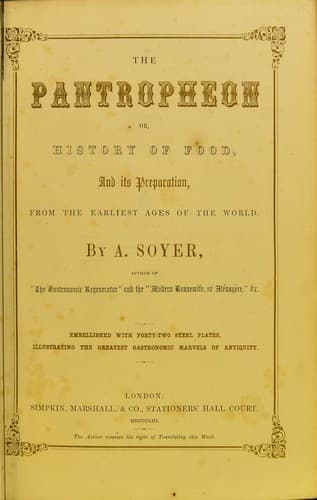
The Pantropheon; Or, History of Food, Its Preparation, from the Earliest Ages of the WorldSoyer, Alexis
History
The Pantropheon; Or, History of Food, Its Preparation, from the Earliest Ages of the World
Soyer, Alexis
Cooking; Food; Gastronomy
The _Mustaceum_ did not deserve to occupy so high a standing; and yet
this rustic cake, composed of sweet wine and flour, a symbol of
abundance and happiness, never failed to be presented to the guests at a
wedding repast, and the newly-married pair sent a piece of it to each of
their absent parents or friends, who, in return, addressed them
congratulations, and wishes for their happiness.[XXIV-16] The mustaceum
was the wedding-cake of the Romans.
Modern civilization has also rejected with equal disdain the _Savillum_
pie, always eaten with pleasure by the voluptuous inhabitants of Rome
when they went to their villas in order to rest from their prodigious
excesses, and from the fatigues of intemperance. This nourishing and
agreeable dish required but little art in its composition. Half-a-pound
of flour and two pounds and a-half of cheese were well mixed together;
three ounces of honey and one egg were then added. When the whole had
been well beaten, it was placed in an earthen vessel rubbed over with
oil, and which was covered with a tart dish cover. It was carefully
watched to see that the process of cooking was going on; afterwards it
was taken from the dish, the pie was smeared with honey, and, for an
instant, replaced under the tart-dish cover, after having dredged the
top with pounded poppy seed. It was always served in the dish in which
it had been cooked, and was eaten with spoons.[XXIV-17]
We have already mentioned the _Artocreas_, a kind of hashed meat mixed
with bread, which Rome borrowed from Greece, together with its original
name. This pie, welcomed by modern gastrophagy, has reached our days
with merely some slight modifications, and deprived of its sonorous
Hellenic appellation.[XXIV-18] Formerly the Roman Emperors, for the
greater part, ruled badly; but, in return, they eat well. In that
gastronomic era--gone, never to return--Cæsar’s supper engaged the
attention of the court, the city, nay, the whole empire. The conquered
universe furnished the details for a banquet, and a royal hand sometimes
deigned to write the ordinance. Now and then, even the monarch, wrapped
in profound culinary meditations, long reflected, dictated to his
_Archimagirus_ a new dish, on which complaisant senators the next day
bestowed enthusiastic praises and a sincere admiration. Thus the Emperor
Verus, inventor of a pie, barely escaped an apotheosis of which his
genius was deemed worthy. It is true that, without any exaggerated
flattery, this pie was excellent, and that never was there imagined a
more happy mixture, a more ingenious combination, of meats, or a more
refined flavour. If any one be curious enough to wish to test this
imperial dish, let him prepare a succulent amalgamation of sow’s flank
(_sumen_), pheasant, peacock, iced ham, and wild boar’s flesh; let him
inclose this mixture within the thick casing of a laboriously worked
crust, and he may attack this kingly dish when a gentle and slow cooking
Public-domain text, read in full here on John Shaqi.
Reviews
Reviews
No reviews yet
Be the first to share your thoughts on this work.
Elsewhere in the archive
Join the Discussion
Join the discussion
Sign in to leave a comment or review.
Sign InorCreate an account