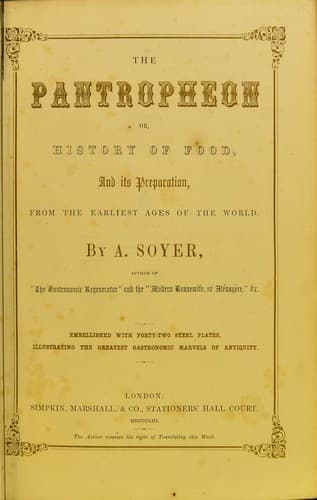
The Pantropheon; Or, History of Food, Its Preparation, from the Earliest Ages of the WorldSoyer, Alexis
History
The Pantropheon; Or, History of Food, Its Preparation, from the Earliest Ages of the World
Soyer, Alexis
Cooking; Food; Gastronomy
These details will, we hope, give a sufficient idea of ancient pastry.
We must remember that these recipes form, as it were, the starting
point. The oil fritter of the Hebrews and the meringues of our period
are wide apart: more than thirty-three centuries separate the two; two
thousand years have elapsed since Cato wrote the recipe for his somewhat
heavy tart. The author of the “Culinary Art,” Apicius himself, is very
old. The private life of the ancient people appears to be worthy of
serious study; but we too often only bestow on it our disdain. The
author of this work has observed their customs in the kitchen and in the
dining-room--the only places to which he had access--and he has taken
the liberty of writing the result of his investigations. Sometimes he
admires, but never does he despise, a civilisation different to our own,
but which was not without its good side. He conjures the reader to
believe him when he says, that whatever eccentricities the gastronomy of
ancient nations may present to us, those people (he has, perhaps,
acquired the right to venture such an assertion) doubtless eat in a very
different manner from ourselves; but they certainly knew how to eat.
The pastry just mentioned is certainly not altogether
irreproachable--that is clear; but many kinds reveal that exquisite
sentiment of the good which is nothing else than taste--whether it
relate to art, literature or cooking--and the entire development of
which seems to have been the appurtenance of a small number of
privileged centuries. Great epochs--such as those of Pericles, Augustus,
Leo XII., Louis XIV., and Queen Anne--have seen roses and myrtles
flourish by the side of the laurels with which the muses are crowned.
Charles XII. was fond of tartlets; Frederic II. gave himself fits of
indigestion by eating Savoy cakes; and the Maréchal de Saxe rested from
the fatigues of glory before a plate of macaroons.
We have renounced the kind of pastry with which our ancestors used to
regale themselves in the 14th century. Their stag pies[XXIV-31] are no
longer in vogue; neither have we any taste for their great pies which
contained a lamb or a stuffed kid, surrounded with goslings by dozens
and scores.[XXIV-32]
Their tarts have fallen into the same oblivion. Who thinks now of their
Janus, or double-faced, tarts, herb tarts, rose-leaf tarts, oat tarts,
or chesnut tarts?[XXIV-33]
Public-domain text, read in full here on John Shaqi.
Reviews
Reviews
No reviews yet
Be the first to share your thoughts on this work.
Elsewhere in the archive
Join the Discussion
Join the discussion
Sign in to leave a comment or review.
Sign InorCreate an account