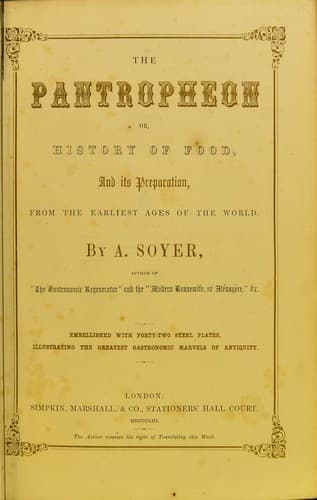
The Pantropheon; Or, History of Food, Its Preparation, from the Earliest Ages of the WorldSoyer, Alexis
History
The Pantropheon; Or, History of Food, Its Preparation, from the Earliest Ages of the World
Soyer, Alexis
Cooking; Food; Gastronomy
The first statutes given to the pastry cooks by St. Louis (May, 1270),
sanctioned their custom of working on all festival days without
exception. Now, the motive for such a toleration was probably this: the
pagans had their festivals, which they passed in banqueting; the Romans
called them _dies epulatæ_.[XXIV-34] The early Christians, although they
gave up the worship of false gods, preserved certain customs in which
they had been brought up, among which was that of public and private
banquets on festival days.[XXIV-35] We still see some remains of these
customs in the village rejoicings on the Continent, on the day of their
patron saint. The Fathers of the Church and the Councils raised their
voices against this abuse;[XXIV-36] but they were obliged to tolerate
it, and the pastry-cooks, who were very busy on those occasions,
profited by the indulgence. It is as well to remark that they were, at
one and the same time, publicans, roasters (that is, they would roast
anything for anybody), and cooks.
Under the ministry of the Chancelier de l’Hôpital, little pies, or
patties, were hawked through all the streets of Paris, and there was an
enormous consumption of them. The severe minister considered them a
luxury, which it was incumbent upon him to suppress; so he prohibited,
not their sale, but the crying of them, as a temptation to gluttony.
There is a kind of cake much in vogue in England, on Good Friday,
designated hot-cross-bun, because it is always marked with a cross. The
reader will, perhaps, take some interest in the observations of Bryant
on the subject of this pastry:--
“The offerings,” says he, “which people in ancient times used to
present to the gods were generally purchased at the entrance of the
temple; especially every species of consecrated bread, which was
denominated accordingly. One species of sacred bread which used to be
offered to the gods was of great antiquity, and called _Boun_.” It was a
kind of cake, with a representation of two horns. Julius Pollux mentions
it after the same manner--a sort of cake with horns. Diogenes Laertius,
speaking of the same offering being made by Empedocles, describes the
chief ingredients of which it was composed:--“He offered one of the
sacred _liba_, called a _bonse_ (_bons_), which was made of fine flour
and honey.”[XXIV-37] England seems, then, to have retained the name and
the form of the ancient _bons_, though the people do not recognise in
the bun anything sacred or holy.
Public-domain text, read in full here on John Shaqi.
Reviews
Reviews
No reviews yet
Be the first to share your thoughts on this work.
Elsewhere in the archive
Join the Discussion
Join the discussion
Sign in to leave a comment or review.
Sign InorCreate an account