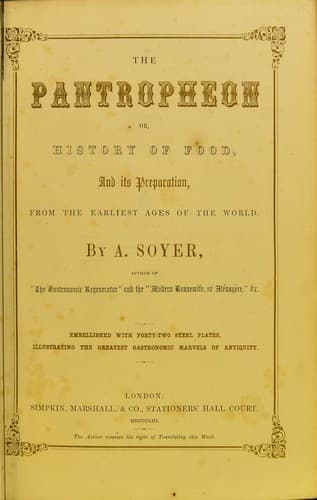
The Pantropheon; Or, History of Food, Its Preparation, from the Earliest Ages of the WorldSoyer, Alexis
History
The Pantropheon; Or, History of Food, Its Preparation, from the Earliest Ages of the World
Soyer, Alexis
Cooking; Food; Gastronomy
Under the reign of Nero, Charmis acquired a great vogue by extolling
cold baths,[XXV-42] even in the depth of winter. This dexterous native
of Marseilles knew so well how to persuade people, that he could hardly
attend to his immense connection; and as he sometimes required as much
as £800 from his patients,[XXV-43] he soon became as celebrated for his
riches as for his pretended medical genius. Who will say, after this,
that the water-cure system is good for nothing?
“In Egypt, rich people have the water brought to them from the Nile in
leather pouches. Large and porous earthen pots of an oval shape, kept up
by supporters, are filled with it. The water at the end of a few hours
has deposited the slime it contained. It is afterwards distributed in
small vases of terra cotta, called _bardaks_, of the size of our
water-jugs. These vases are taken in the most showy part of the
habitation. In a short time the clay of the _bardaks_ is impregnated;
their surface is covered with water, which, after borrowing from the
liquid within the caloric it requires for evaporation, reduces this to a
temperature of six or seven degrees under that which it had
before.”--PARMENTIER.
More than five centuries ago the Sieur de Joinville described the same
process. “The water of the Nile,” he said, “is of such a nature, that
when we hung it in white earthen pots, made in the country, to the
rigging of our ships, the water became in the heat of the day as cold as
spring-water.”[XXV-44]
Sea-water is not potable, but it has long since been remarked that the
vapours which rise from the sea are soft, and it was thence concluded
that, by collecting and condensing them, it would be possible to obtain
a potable liquid fit for domestic purposes. This phenomenon was known in
the time of Pliny, who informs us that, “fleece spread about the ship,
after having received the exhalations from the sea, becomes damp, and
that fresh water may be extracted from it.”[XXV-45]
About the middle of the last century means were found to remove
DESCRIPTION OF PLATE No. XVII.
No. 1. Pail, of bronze, with movable handle, covered with
hieroglyphics, to carry water from the Nile for the Feast of Isis.
No. 2. Pail, with two handles, same metal, placed on a small tripod
to stand upon, owing to the convexity of the bottom.--ST. NON,
“_Herculaneum_.”
the saline substances from sea-water. Boyle, Leibnitz, the Count of
Marsigli--all had made a great number of fruitless experiments. Mr.
Poissonnier invented a very simple distillating machine, with which, and
an absorbing powder, he succeeded in depriving sea-water of its
insufferable bitterness, and rendering it perfectly salubrious. About
1784, a successful experiment was made at York with a machine which
produced the same result.
Public-domain text, read in full here on John Shaqi.
Reviews
Reviews
No reviews yet
Be the first to share your thoughts on this work.
Elsewhere in the archive
Join the Discussion
Join the discussion
Sign in to leave a comment or review.
Sign InorCreate an account