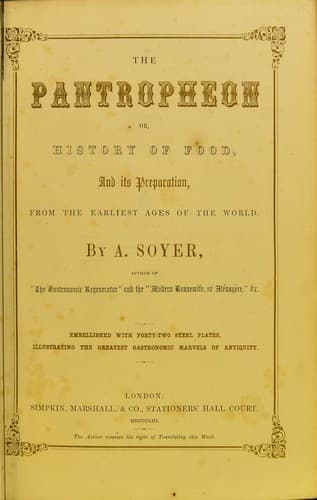
The Pantropheon; Or, History of Food, Its Preparation, from the Earliest Ages of the WorldSoyer, Alexis
History
The Pantropheon; Or, History of Food, Its Preparation, from the Earliest Ages of the World
Soyer, Alexis
Cooking; Food; Gastronomy
Some travellers have related, that, at the Iron Island, the only soft
water was that which was collected from a large tree, in the centre of
the island, and which was incessantly covered with clouds. The water ran
continually from the leaves, and fell into two large cisterns,
constructed at the foot of the tree, which, according to Jackson,
furnished enough for 8,000 souls, and 100,000 cattle. “Let us see,” says
Bory de Saint-Vincent, “what amount of credit is due to the marvellous
tree of the Iron Island.” Abreu Galindo, in his manuscript treatise on
the Canary Islands, preserved in the archives of the country, says that
he wished to see with his own eyes what the tree was. He embarked,
arrived, took a guide to conduct him to a place called Tigulahe, which
is separated from the sea by a valley, and there, at the extreme
boundary, under a large cliff, was the holy tree, which in the country
is called Garoë. Its trunk is twelve spans in circumference, four feet
in diameter, and nearly forty feet in height. The branches are wide
apart and tufted; its fruit resembles an acorn, and the kernel is, in
colour and taste, like the little aromatic almonds which pine nuts
contain. It never loses its leaves, that is to say, the old ones do not
fall until the young ones are formed. On the north side, are two large
stone pillars, of twenty square feet, hollowed out to a depth of twenty
spans. These pillars are so placed that the water falls into one, and is
preserved in the other. Vapours and mists rise almost every day from the
sea, particularly in the morning, and at no great distance in the
offing; these vapours are carried by the east wind against the cliffs,
which block their passage, so that they cover the tree, become condensed
on its smooth leaves, and run off drop by drop. The more the east wind
reigns, the more abundant is the supply of water. It is distributed by a
man who guards the tree. A whirlwind tore up the Garoë in 1625.[XXV-46]
XXVI.
BEVERAGES, OF WHICH WATER IS THE FOUNDATION.
Water is certainly the most ancient beverage, the most simple, natural,
and the most common, which nature has given to mankind. But it is
necessary to be really thirsty in order to drink water, and as soon as
this craving is satisfied it becomes insipid and nauseous. What is then
to be done? Cyrus would have said: “Drink no more;” so would a
teetotaler of the present day. In the first ages of the world, the human
race, bound by no oath of temperance, succeeded, by sheer application of
their ingenuity, in finding something better, or perhaps worse,
according to the ideas of certain moralists, whose wise teaching,
however, commands respect. Certain it is that water, continuing to be
regarded with peculiar favour, was called to play a principal part in
various combinations by which it lost its insipidity and inoffensive
properties, and acquired the wonderful power of provoking a sort of
madness, known by the name of drunkenness.
Public-domain text, read in full here on John Shaqi.
Reviews
Reviews
No reviews yet
Be the first to share your thoughts on this work.
Elsewhere in the archive
Join the Discussion
Join the discussion
Sign in to leave a comment or review.
Sign InorCreate an account