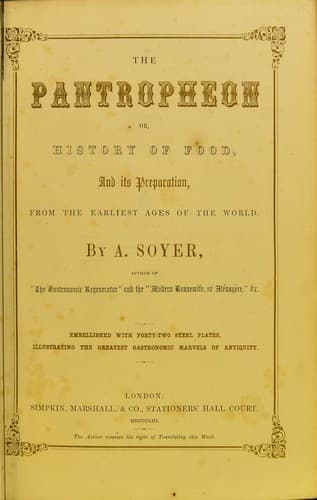
The Pantropheon; Or, History of Food, Its Preparation, from the Earliest Ages of the WorldSoyer, Alexis
History
The Pantropheon; Or, History of Food, Its Preparation, from the Earliest Ages of the World
Soyer, Alexis
Cooking; Food; Gastronomy
The Danes and Saxons gave themselves up to an enormous consumption of
zythum and curmi, kinds of ale and beer, varying in no other respect
than in the manner of preparing them.[XXVI-17] The warlike piety of
their ingenuous and coarse-minded heroes, desired no greater recompense,
after a life of fatigue and rough combats, than to sing the praises of
Odin amidst eternal banquets, where these exhilarating beverages might
unceasingly maintain the joy and bravery of the warriors.[XXVI-18]
The ancient Britons had many vines, but they esteemed them only as
ornaments to their gardens; and they preferred, says Cæsar, the wine of
grain to that of grapes.[XXVI-19] It is historically demonstrated that
the English, at a very early epoch, applied themselves to the making of
beer.
It is mentioned in the laws of Ina, Chief, or King, of Wessex; and this
liquor held a distinguished rank among those that appeared at a royal
feast in the reign of Edward the Confessor.[XXVI-20]
Under the Normans, ale acquired a reputation it has ever since
maintained. Two gallons cost only one penny in the cities; in the
country, four gallons might be obtained at the same price. Happy age!
happy ale drinkers! At that period--the golden age for the apostles of
the Britannic Bacchus--the brewers rendered no account of the
preparation of this beloved beverage. The English nation did not yet
purchase the right of intoxicating themselves: it was not till the year
1643 that this authorization was to be bought.[XXVI-21]
The use of hops would appear to be of German invention. They were
employed in the Low Countries at the beginning of the 14th century; but
it was not till the 16th that they were appreciated in England.[XXVI-22]
Can it be true that beer or ale possessed, in certain cases, strange
curative properties? We find the following fact in a statistical account
of Scotland.[XXVI-23]
A poor coal miner of the county of Clackmannan, named William Hunter,
had been long suffering with acute rheumatism, or obstinate gout, which
deprived him of the use of his limbs. The eve of the first Monday of the
year 1758, some of his neighbours came to pass the evening with him. Ale
was drunk, and they got merry. The jolly fellow never failed to empty
his glass at each round. Scotch ale is a seductive drink, and as
perfidious as pleasure: it bewilders the senses, and finally masters the
reason. William Hunter lost his, completely; but his legs were restored,
and he was able to make marvellous use of them for more than twenty
years. After that happy evening, never did his old enemy, the gout, dare
approach him; and the worthy coal miner took care to keep it at a
distance, by reiterating the remedy which had proved so beneficial.
Nobody could blame him. Ale had become so dear to him! Gratitude and
prudence combined to make it a duty to remain unalterably attached, and
he was faithful to it till he breathed his last.
Antecedent to the use of hops beer was made in England as follows:
Public-domain text, read in full here on John Shaqi.
Reviews
Reviews
No reviews yet
Be the first to share your thoughts on this work.
Elsewhere in the archive
Join the Discussion
Join the discussion
Sign in to leave a comment or review.
Sign InorCreate an account