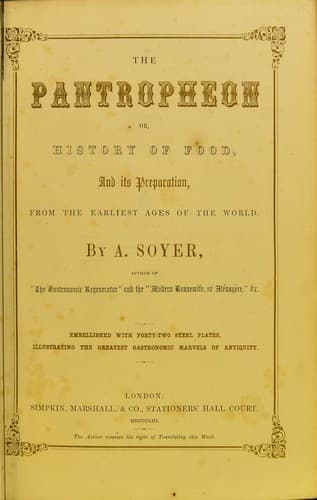
The Pantropheon; Or, History of Food, Its Preparation, from the Earliest Ages of the WorldSoyer, Alexis
History
The Pantropheon; Or, History of Food, Its Preparation, from the Earliest Ages of the World
Soyer, Alexis
Cooking; Food; Gastronomy
Those beverages which man imbibes when he is no longer thirsty, which
cloud his weak mind, and render him ill when in good health, are called
fermented liquors.
Beer is one of the most ancient. If we are to believe Diodorus of
Sicily, Bacchus himself invented it.[XXVI-1] However, it is certain that
the absolute injunction not to drink wine, caused the inhabitants of
Egypt to have recourse to a factitious beverage obtained from
barley,[XXVI-2] often mentioned in history under the name of _zythum_
and _curmi_,[XXVI-3] and whose invention has been often attributed to
Osiris--which means, that its precise origin is entirely unknown.
It was a kind of beer composed of barley, and capable of being preserved
for a long time without decomposing;[XXVI-4] for instead of hops,
utterly unknown in that country, a bitter infusion of lupins was
added.[XXVI-5]
The Egyptians also used Assyrian corn in its composition, and probably
other aromatic plants, in which each one followed his peculiar taste.
The method of brewing varied much among them;[XXVI-6] but the one here
mentioned was that most generally in use to procure zythum in Lower
Egypt, where it was converted, like our beer, into vinegar, which the
Greek merchants of Alexandria exported to the European ports.[XXVI-7]
The Egyptians long drank nothing but this fermented liquor, because the
followers of Osiris believed that when Jupiter crushed the Titans with
thunderbolts, their blood, mixing with the earth, produced the vine.
They invented the zythum as a substitute for wine.[XXVI-8]
It is not probable that the Greeks, whose wines were so renowned in
antiquity, thought much of beer. Nevertheless, Aristotle[XXVI-9]
mentions drunkenness being caused by drinking a beverage drawn from
barley. Æschylus[XXVI-10] and Sophocles[XXVI-11] mention a liquor
procured from the same cereal.
The use of beer spread rapidly in Gaul, where wine was but little known
before the time of Probus. The Emperor Julian, governor of this country,
acquaints us of this fact in an epigram.[XXVI-12]
The Spaniards, and the aborigines of Britany and Germany, also
delightfully intoxicated themselves with an “infusion of barley,” called
by the first of these nations, _cœlia_, _ceria_,
_cerevisia_,[XXVI-13] and _curmi_ by the two latter. These various
denominations signify literally, _strong water_,[XXVI-14] and this
fermented drink was common to the nations just indicated.[XXVI-15] All
the people of Western Europe drank a strong liquor made with grain and
water. The manner of preparing it was not the same in Spain, in Gaul,
and elsewhere; but everywhere it possessed the same dangerous
properties.
“Man,” says Pliny, “is so skilful in flattering his vices, that he has
even found means to render water poisonous and intoxicating.”[XXVI-16]
Public-domain text, read in full here on John Shaqi.
Reviews
Reviews
No reviews yet
Be the first to share your thoughts on this work.
Elsewhere in the archive
Join the Discussion
Join the discussion
Sign in to leave a comment or review.
Sign InorCreate an account