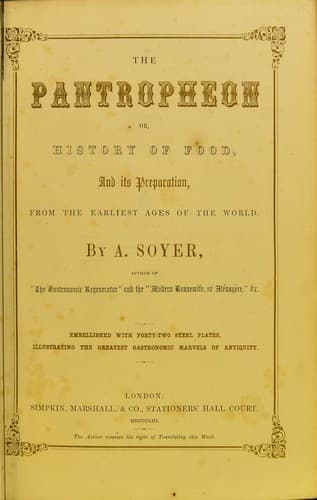
The Pantropheon; Or, History of Food, Its Preparation, from the Earliest Ages of the WorldSoyer, Alexis
History
The Pantropheon; Or, History of Food, Its Preparation, from the Earliest Ages of the World
Soyer, Alexis
Cooking; Food; Gastronomy
Holinshed says[XXVI-26] that every kind of wine could be procured in
England. “Nevertheless,” he adds, “ale and beere beare the greatest
brunt in drincking, which are of so many sortes and ages as it pleaseth
the brewer to make them. The beere that is used at noblemen’s tables is
commonly of a yeare olde (or, peradventure, of twoo yeares’ tunning, or
more, but this is not general); it is also brued in Marche, and is
therefore called Marche beere; but for the household it is usually not
under a monthe’s age, eache one coveting to have the same stale as he
might, so that was not soure, and the breade new as possible, so that be
not hote.”
Formerly, they drank beer in some parts of France--in others, wine.
Perhaps it is the same now. This difference of taste gave rise to a
rather jocose dispute between a grey friar and a white friar. One, who
was a Fleming, was for beer; the other, who was from Bordeaux, was for
wine. The Fleming cited passages without number from antiquity in proof
of the excellence of beer, known by the ancients under the name of
_zithum_, or _curmi_. The one from Bordeaux was not so learned, but he
was a native of Bordeaux, and with one word he terminated the dispute.
“Brother,” said he to his adversary, “I maintain that there is as much
difference between wine and beer as there is between St. Francis and St.
Dominick.” The whole community were for the Bordeaux monk, and the
Fleming was reduced to silence.[XXVI-27]
_Braket_ was formerly the cherished drink of the lower classes in
England. Arnold describes the preparation of it, in his “Chronicles of
London:”
“Take a pot of good ale and put thereto a porcyon of honey and pepper,
in this manner:--When thou hast good ale, lete it stonde (stand) in a
pott two dayes, and then drawe out a quart, or a pottell, of that ale,
and putt to the honey, and set it over the fyre and let it sethe well,
and take it of the fyre and scume it clene; and then sat it over the
fyre and scume it agayne, and then let it keele a whyle, and put thereto
the pepper, and then set hym on the fyre and let him boyle well togyder,
with esy fyre, but clere. Take four gallons of good ale, a pynte of fyn
tryed hony, and about a saucerful of powder of peper.”
Beer was hot unknown in Italy, but the Romans never granted it their
serious attention.[XXVI-28] We will give a brief sketch of those
beverages which, among them and the Greeks, replaced wine with greater
or less advantage.
Public-domain text, read in full here on John Shaqi.
Reviews
Reviews
No reviews yet
Be the first to share your thoughts on this work.
Elsewhere in the archive
Join the Discussion
Join the discussion
Sign in to leave a comment or review.
Sign InorCreate an account