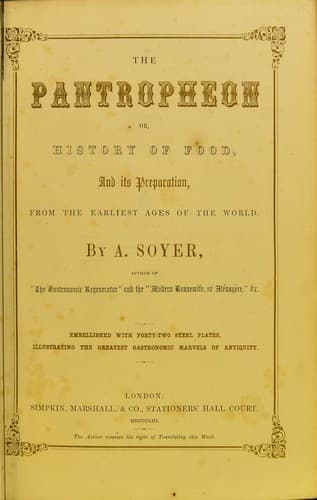
The Pantropheon; Or, History of Food, Its Preparation, from the Earliest Ages of the WorldSoyer, Alexis
History
The Pantropheon; Or, History of Food, Its Preparation, from the Earliest Ages of the World
Soyer, Alexis
Cooking; Food; Gastronomy
Convalescents, sober persons who resisted the sweet seductions of
Falernian and Chios wines, drank a kind of barley-water _ptisana_, a
sorry liquid, of which the following is the recipe for the use of the
abstemious of the present day. They placed barley in water, and left it
there until it swelled; it was then dried in the sun, then beaten to
deprive it of its husk, and ground. Then, when it had been boiled in
water for a long time, it was again exposed to the sun. When they wished
to drink barley-water, a small quantity of this flour was boiled, the
water was strained off, and a few drops of vinegar were added.[XXVI-29]
The disciples of Comus have always shuddered at this beverage, when only
mentioned.
The _oxycratus_ was not much better. It was a mixture of water and
vinegar, with which the lower orders contented themselves when they
could obtain nothing more exhilarating to drink;[XXVI-30] and with which
the soldiers, especially in the camp, were compelled to quench their
thirst.[XXVI-31]
Some passages from Pliny, and also from other authors, prove that the
ancients were acquainted with cider.[XXVI-32] It is, however, asserted
that the use of this beverage goes no farther back than three or four
centuries, either in England or France;[XXVI-33] but this cannot be a
fact with regard to the last-named country, since the capitulars of
Charlemagne place among the number of ordinary trades that of
_sicerator_, or “cider maker.” This “wine of apples,”[XXVI-34] it is
said, was very common among the Hebrews. That is possible, but it would,
nevertheless, be difficult to prove it from the holy writings, since the
word _schecar_, which has been translated by _sicera_, and which, again,
has been rendered into cider, signifies all kinds of intoxicating
beverage, whether made from grain, honey, or fruit.[XXVI-35]
Gaul, covered with forests, and swarming with bees, possessed an immense
quantity of wild honey, of which, by the aid of fermentation in water,
the inhabitants composed a strong and intoxicating drink, called
_hydromel_. This beverage, highly esteemed both in Rome and Greece, was
prepared in the following manner: rain water was kept some time, and
then boiled until reduced to one-third, to which honey was added.[P]
This mixture was exposed to the sun for the space of forty days; it was
then placed in a vessel, and by these means they obtained, in time, a
vinous hydromel very similar to our Madeira wine.[XXVI-36] To make
_oxymel_, still more heady, ten pounds of honey were mixed with two
pints and a half of old vinegar, and one pound of sea-salt; the whole
boiled only an instant in five pints of water. This liquor was left to
get very old.[XXVI-37]
Juice of quinces and honey, boiled in water, produced _hydromelon_, a
delicious drink, which our century might envy the delicate drinkers of
Athens and Rome,[XXVI-38] especially when roses had been added to this
nectar, which changed it into _hydrorosatum_.[XXVI-39]
Public-domain text, read in full here on John Shaqi.
Reviews
Reviews
No reviews yet
Be the first to share your thoughts on this work.
Elsewhere in the archive
Join the Discussion
Join the discussion
Sign in to leave a comment or review.
Sign InorCreate an account